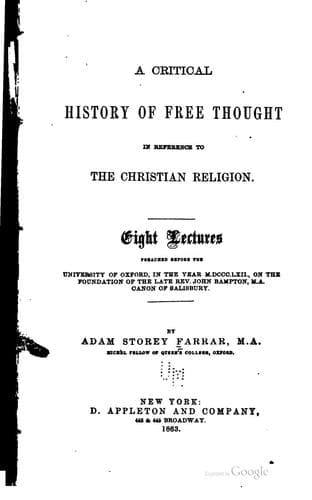
History of Free Thought in Reference to The Christian Religion — John Shaqi
History of Free Thought in Reference to The Christian ReligionFarrar, Adam Storey
History
History of Free Thought in Reference to The Christian Religion
Farrar, Adam Storey
Free thought -- History
Such a study would also furnish valuable data for determining precisely
the variation of form which alteration of conditions causes in the
development of such a struggle. In the East, the history of religion, for
which material is supplied by the study of the Zend and Sanskrit
literature, (3) would furnish examples of attempts made by philosophers to
find a rational solution of the problems of the universe, and to adjust
the theories of speculative thought to the national creed deposited in
supposed sacred books. And though, in a western nation such as Greece, the
separation of religion from philosophy was too wide to admit of much
parallel in the speculative aspect of free thought, yet in reference to
the critical, many instances of the application of an analogous process to
a national creed may be seen in the examination made of the early
mythology, the attempt to rationalize it by searching for historical data
in it, or to moralize it by allegory.(66) Again, within the sphere of the
Hebrew religion which, though supernaturally suggested, developed in
connexion with human events so as to admit the possibility of the rise of
mental difficulties in the progress of its history, how much hallowed
truth, both theoretical and practical, might be learned from the divine
breathings of pious inquirers, such as the sacred authors of the
seventy-third Psalm, or of the books of Job and Ecclesiastes, which give
expression to painful doubts about Providence, not fully solved by
religion, but which nevertheless faith was willing to leave
unexplained.(67) If in the Oriental systems free thought is seen to
operate on a national creed by adjusting it to new ideas through
philosophical dogmatism; if in the Greek by explaining it away through
scepticism; in the Hebrew it is hushed by the holier logic of the
feelings. The two former illustrate steps in the intellectual progress of
free thought; the last exhibits the moral lesson of resignation and
submission in the soul of the inquirer.
Public-domain text, read in full here on John Shaqi.
Reviews
Reviews
No reviews yet
Be the first to share your thoughts on this work.
Join the Discussion
Join the discussion
Sign in to leave a comment or review.
Sign InorCreate an account