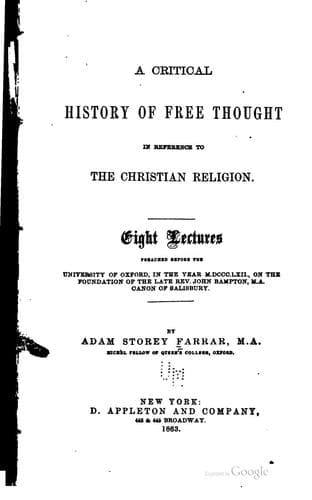
History of Free Thought in Reference to The Christian ReligionFarrar, Adam Storey
History
History of Free Thought in Reference to The Christian Religion
Farrar, Adam Storey
Free thought -- History
Nor has the activity of reason used in defence been less manifest in these
later movements. The great works on the Christian evidences are the
witness to its presence; and the deeper and truer appreciation of
Christianity now shown in every country, and the increasing interest felt
in religion, are the indirect effect, under the guidance of divine
Providence, of the stirring of the religious apprehension by
controversy.(73)
We have thus at once exhibited the province which will be hereafter
investigated in detail, and stated the general law observable in the
conflict between free thought and Christianity. The type reappears,
perpetuated by the fixity of mind, though the form varies under the force
of circumstances. Christianity being stationary and authoritative, thought
progressive and independent, the causes which stimulate the restlessness
of the latter interrupt the harmony which ordinarily exists between belief
and knowledge, and produce crises during which religion is re-examined.
Disorganization is the temporary result; theological advance the
subsequent. Whatever is evil is eliminated in the conflict; whatever is
good is retained. Under the overruling of a beneficent Providence,
antagonism is made the law of human progress.
The restriction of our inquiry to the consideration of the free action of
reason will cause our attention to be almost entirely confined to the
operation of reason in its attack on Christianity, to the neglect of the
evidences which the other office of it has presented in defence; and will
also exclude altogether the study of struggles, where the opposition to
Christianity has rested on an appeal to the authority of rival sacred
books; such for example as the conflict with rival religions like the
Jewish (4) or Mahometan (5); as well as of heresies which, like the
Socinian (6), claim, however unjustly, to rest on the authority of the
Christian revelation.
The law thus sketched of this struggle needs fuller explanation. We must
employ a more exact analysis to gain a conception of the causes which have
operated at different periods to make free thought develop into unbelief.
It will be obvious that the causes must depend, either upon the nature of
the Christian religion, which is the subject, or of the mind of man, which
is the agent of attack. The former were touched upon in the opening
remarks of this lecture, and may be reconsidered hereafter;(74) but it is
necessary to gain a general view of the latter before treating them in
their application in future lectures.
Public-domain text, read in full here on John Shaqi.
Reviews
Reviews
No reviews yet
Be the first to share your thoughts on this work.
Join the Discussion
Join the discussion
Sign in to leave a comment or review.
Sign InorCreate an account