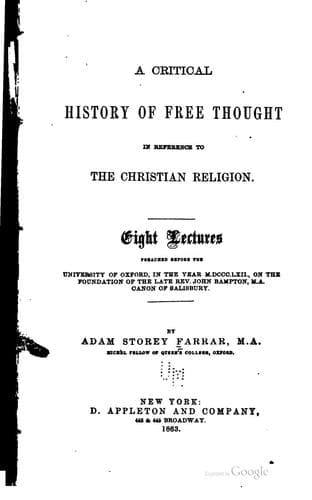
History of Free Thought in Reference to The Christian Religion — John Shaqi
History of Free Thought in Reference to The Christian ReligionFarrar, Adam Storey
History
History of Free Thought in Reference to The Christian Religion
Farrar, Adam Storey
Free thought -- History
These causes, so far as they are spiritual and disconnected from admixture
with political circumstances, may be stated to be of two kinds, viz.
intellectual and moral; the intellectual explaining the types of thought,
the moral the motives which have from time to time existed.(75) The
actions, and generally the opinions of a human being, are the complex
result arising from the union of both. Yet the two elements, though
closely intertwined in a concrete instance, can be apprehended separately
as objects of abstract thought; and the forms of manifestation and mode of
operation peculiar to each can be separately traced.
In a history of thought, the antagonism created by the intellect rather
than by the heart seems the more appropriate subject of study, and will be
almost exclusively considered in these lectures. Nevertheless a brief
analysis must be here given of the mode in which the moral is united with
the intellectual in the formation of opinions. This is the more necessary,
lest we should seem to commit the mistake of ignoring the existence or
importance of the emotional element, if the restriction of our point of
view to the intellectual should hereafter prevent frequent references to
it.
The influence of the moral causes in generating doubt, though sometimes
exaggerated, is nevertheless real. Psychological analysis shows that the
emotions operate immediately on the will, and the will on the intellect.
Consequently the emotion of dislike is able through the will to prejudice
the judgment, and cause disbelief of a doctrine against which it is
directed.(76) Nor can we doubt that experience confirms the fact. Though
we must not rashly judge our neighbour, nor attempt to measure in any
particular mind the precise amount of doubt which is due to moral causes,
yet it is evident that where a freethinker is a man of immoral or
unspiritual life, whose interests incline him to disbelieve in the reality
of Christianity, his arguments may reasonably be suspected to be suggested
by sins of character, and by dislike to the moral standard of the
Christian religion, and, though not on this account necessarily
undeserving of attention, must be watched at every point with caution, in
order that the emotional may be eliminated from the intellectual causes.
Public-domain text, read in full here on John Shaqi.
Reviews
Reviews
No reviews yet
Be the first to share your thoughts on this work.
Join the Discussion
Join the discussion
Sign in to leave a comment or review.
Sign InorCreate an account