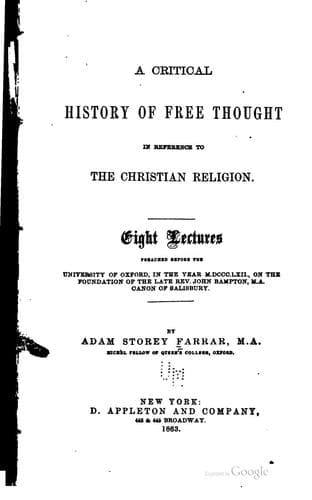
History of Free Thought in Reference to The Christian ReligionFarrar, Adam Storey
History
History of Free Thought in Reference to The Christian Religion
Farrar, Adam Storey
Free thought -- History
It is at this time too that we meet with an attempt to hold the Christians
up to ridicule in a satire of Lucian,(139) which well exemplifies the
views belonging to the sceptical of the four classes into which we have
divided the religious opinions of the heathens. His tract, the Peregrinus
Proteus, it can hardly be doubted, is intended as a satire on Christian
martyrdom (13). Peregrinus(140) is a Cynic philosopher, who after a life
of early villainy is made by Lucian to play the hypocrite at Antioch and
join himself to the Christians, “miserable men” (as he calls them), “who,
hoping for immortality in soul and body, had a foolish contempt of death,
and suffered themselves to be persuaded that they were brethren, because,
having abandoned the Greek gods, they worshipped the crucified sophist,
living according to his laws.”(141) Peregrinus, when a Christian, soon
rises to the dignity of bishop, and is worshipped as a god; and when
imprisoned for his religion is visited by Christians from all quarters.
Afterwards, expelled the church, he travels over the world; and at last
for the sake of glory burns himself publicly at Olympia about A.D. 165.
His end is described in a tragico-comic manner, and a legend is recounted
that at his death he was seen in white, and that a hawk ascended from his
pyre.
Lucian has here used a real name to describe a class, not a person. He has
given a caricature painting from historic elements. There seems internal
evidence to show that he was slightly acquainted with the books of the
early Christians.(142) It has even been conjectured that he might have
read and designed to parody the epistles of Ignatius.(143) With more
probability we may believe that he had heard of and misunderstood the
heroic bearing of the Christian martyrs in the moment of their last
suffering. Pope Alexander VII. in 1664 placed this tract in the index of
prohibited books: yet even beneath the satire we rather hail Lucian as an
unconscious witness to several beautiful features in the character of the
Christians of his time:(144) viz. their worship of “the crucified
sophist,” who was their adorable Lord; their guilelessness; their
brotherly love; their strict discipline; their common meals; their union;
their benevolence; their joy in death. The points which he depicts in his
satire are, their credulity in giving way to Peregrinus; their
unintelligent belief in Christ and in immortality; their factiousness in
aiding Peregrinus when in prison; their pompous vanity in martyrdom, and
possibly their tendency to believe legends respecting a martyr’s death.
His satire is contempt, not anger, nor dread. It is the humour of a
thorough sceptic, which discharged itself on all religions alike; and
indicates one type of opposition to Christianity; viz. the contempt of
those who thought it folly.
Public-domain text, read in full here on John Shaqi.
Reviews
Reviews
No reviews yet
Be the first to share your thoughts on this work.
Elsewhere in the archive
Join the Discussion
Join the discussion
Sign in to leave a comment or review.
Sign InorCreate an account