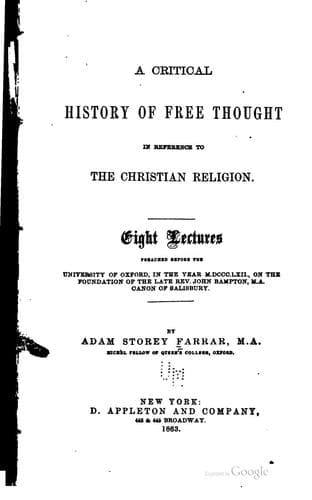
History of Free Thought in Reference to The Christian ReligionFarrar, Adam Storey
History
History of Free Thought in Reference to The Christian Religion
Farrar, Adam Storey
Free thought -- History
Very unlike to him was his well-known contemporary Celsus. If the one
represents the scoffer, the other represents the philosopher. Not
despising Christianity with scorn like Tacitus, nor jeering at it with
humour like Lucian, Celsus had the wisdom to apprehend danger to
heathenism, measuring Christianity in its mental and not its material
relations; and about the reign of Marcus Aurelius wrote against it a work
entitled Λόγος ἀληθής, which was considered of such importance, that
Origen towards the close of his own life(145) wrote a large and elaborate
reply to it.
We know nothing of Celsus’s life.(146) There is even an uncertainty as to
the school of philosophy to which he belonged. External evidence seems to
testify that he was an Epicurean; but internal would lead us to classify
him with the Platonic. Unscrupulous in argument, confounding canonical
gospels with apocryphal, and Christians with heretical sects, delighting
in searching for contradictions, incapable of understanding the deeper
aspects of Christianity, he has united in his attack all known objections,
making use of minute criticism, philosophical theory, piquant sarcasm, and
eloquent invective, as the vehicle of his passionate assault.
It is impossible to recover a continuous account of the work of Celsus
from the treatise of his respondent; but a careful study of the fragments
embedded in the text of Origen will perhaps restore the framework of the
original sufficiently to enable us to perceive the points of his
opposition to Christianity, and the manner in which his philosophy stood
in the way of the reception of it. (14)
Celsus commences by introducing a Jewish rabbi to attack Christianity from
the monotheistic stand-point of the earlier faith.(147) The Jew is first
made to direct his criticism against the documents of Christianity, and
then the facts narrated.(148) He points out inconsistencies in the gospel
narratives of the genealogy of Christ;(149) utters the most blasphemous
calumnies concerning the incarnation;(150) turns the narrative of the
infancy into ridicule;(151) imputes our Saviour’s miracles to magic;(152)
attacks his divinity;(153) and concentrates the bitterest raillery on the
affecting narrative of our blessed Lord’s most holy passion. Each fact of
deepening sorrow in that divine tragedy, the betrayal,(154) the mental
anguish, the sacred agony,(155) is made the subject of remarks
characterized no less by coarseness of taste and unfairness, than to the
Christian mind by irreverence. Instead of his heart being touched by the
majesty of our Saviour’s sorrow, Celsus only finds an argument against the
divine character of the adorable sufferer.(156) The wonders accompanying
Christ’s death are treated as legends;(157) the resurrection regarded as
an invention or an optical delusion.(158)
Public-domain text, read in full here on John Shaqi.
Reviews
Reviews
No reviews yet
Be the first to share your thoughts on this work.
Elsewhere in the archive
Join the Discussion
Join the discussion
Sign in to leave a comment or review.
Sign InorCreate an account