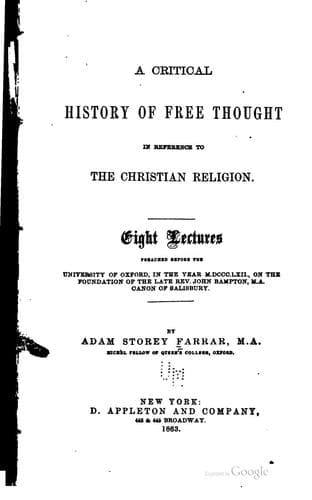
History of Free Thought in Reference to The Christian ReligionFarrar, Adam Storey
History
History of Free Thought in Reference to The Christian Religion
Farrar, Adam Storey
Free thought -- History
After Celsus has thus made the Jew the means of a ruthless attack on
Christianity, he himself directs a similar one against the Jewish religion
itself.(159) He goes to the origin of their history; describes the Jews as
having left Egypt in a sedition;(160) as being true types of the
Christians in their ancient factiousness;(161) considers Moses to be only
on a level with the early Greek legislators;(162) regards Jewish rites
like circumcision to be borrowed from Egypt; charges anthropomorphism on
Jewish theology,(163) and declines allowing the allegorical interpretation
in explanation of it;(164) examines Jewish prophecy, parallels it with
heathen oracles,(165) and claims that the goodness not the truth of a
prophecy ought to be considered;(166) points to the ancient idolatry of
the Jews as proof that they were not better than other nations;(167) and
to the destruction of Jerusalem as proof that they were not special
favourites of heaven. At last he arrives at their idea of creation,(168)
and here reveals the real ground of his antipathy. While he objects to
details in the narrative, such as the mention of days before the existence
of the sun,(169) his real hatred is against the idea of the unity of God,
and the freedom of Deity in the act of creation. It is the struggle of
pantheism against theism.
When Celsus has thus made use of the Jew to refute Christianity from the
Jewish stand-point, and afterwards refuted the Jew from his own, he
proceeds to make his own attack on Christianity; in doing which, he first
examines the lives of Christians,(170) and afterwards the Christian
doctrine;(171) thus skilfully prejudicing the mind of his readers against
the persons before attacking the doctrines. He alludes to the
quarrelsomeness shown in the various sects of Christians,(172) and repeats
the calumnious suspicion of disloyalty,(173) want of patriotism,(174) and
political uselessness;(175) and hence defends the public persecution of
them.(176) Filled with the esoteric pride of ancient philosophy, he
reproaches the Christians with their carefulness to proselytize the
poor,(177) and to convert the vicious;(178) thus unconsciously giving a
noble testimony to one of the most divine features in our religion, and
testifying to the preaching of the doctrine of a Saviour for sinners.
Public-domain text, read in full here on John Shaqi.
Reviews
Reviews
No reviews yet
Be the first to share your thoughts on this work.
Elsewhere in the archive
Join the Discussion
Join the discussion
Sign in to leave a comment or review.
Sign InorCreate an account