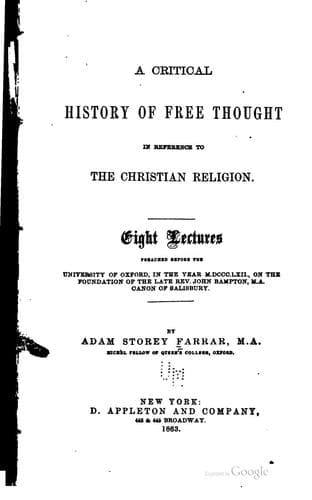
History of Free Thought in Reference to The Christian ReligionFarrar, Adam Storey
History
History of Free Thought in Reference to The Christian Religion
Farrar, Adam Storey
Free thought -- History
The two theories were of universal application to every subject of
thought. An illustration will explain their relation to theology. In the
foolish and almost irreverent attempts to explain by philosophy the nature
of the triune existence of the divine Being, the realist assuming the
reality of the one genus Deity, was prepared to allow identity of essence
in the three species, the three members of the Divine Trinity. The
nominalist, allowing only concrete existence, was obliged either to accept
unity, only in a verbal sense, and be charged with tritheism, as Roscelin;
or diversity only in a verbal sense, and incur the charge of Sabellianism,
as Abélard.
Such was Scholasticism, and such its relation to philosophy and
theology.(262) Existing for several centuries as an instinct, it became
about the end of the eleventh century an intelligent movement.(263) At
this period the problem was consciously proposed, and each of the three
centuries which are comprised in our present period exhibits a different
phase of the controversy. At first the movement was in favour of the
nominalism in Roscelin and Abélard, and reason assumed an attitude of
alleged scepticism: in the thirteenth century the victory was in the hands
of intelligent realists like Aquinas, who used reason in favour of
orthodoxy. In the fourteenth, nominalism revived in Occam; the provinces
of faith and philosophy were severed, and the final victory on the
metaphysical question remained in the hands of the nominalists.
The scientific position of Abélard will thus be clear. We must now study
his intellectual character, as embodying the sceptical aspect which
belonged to nominalism.
Abélard’s character is in many respects one of the most curious in
history.(264) The record of his trials, bodily and mental,(265) enlists
the romantic sympathy of the sentimentalist, and commands the serious
attention of the philosopher. His wonderful reputation at Paris as a
public lecturer connects him with the university life of the middle ages,
and presents him as the type of the class of great professors created by
the absence of books and consequent prevalence of oral instruction. It was
his vast influence which made his opinions of importance, and aroused the
opposition of St. Bernard. It seems to have been the application of the
nominalist philosophy to the doctrine of the Trinity, contained in
Abélard’s works on dogmatic theology,(266) which excited alarm. The
council called at Sens(267) was a theological duel, wherein those two
distinguished characters were matched, the most eloquent theologian and
preacher against the most influential professor and philosopher; the saint
against the critic. Bernard was right in his Theology; Abélard perhaps
right in his philosophy.(268) This event however presents the effects of
scholasticism in producing heresy rather than scepticism.
Public-domain text, read in full here on John Shaqi.
Reviews
Reviews
No reviews yet
Be the first to share your thoughts on this work.
Elsewhere in the archive
Join the Discussion
Join the discussion
Sign in to leave a comment or review.
Sign InorCreate an account