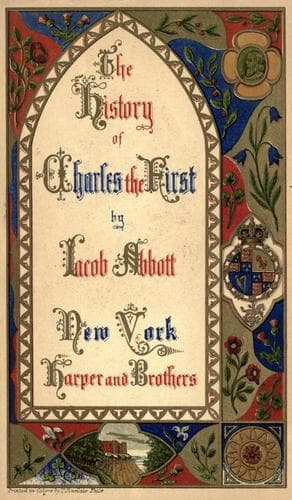
History of King Charles the First of EnglandAbbott, Jacob
History
History of King Charles the First of England
Abbott, Jacob
Charles I, King of England, 1600-1649; Great Britain -- History -- Charles I, 1625-1649; Great Britain -- Kings and rulers -- Biography
The people of England submitted to be governed by such men, not because
they thought them qualified to govern, or that the circumstances
under which their characters were formed were such as were calculated
to form, in a proper manner, the minds of the rulers of a Christian
people. They did not know what those circumstances were. In their
conceptions they had grand ideas of royal character and life, and
imagined the splendid palaces which some saw, but more only heard of,
at Westminster, were filled with true greatness and glory. They were
really filled with vulgarity, vice, and shame. James was to them King
James the First, monarch of Great Britain, France, and Ireland, and
Charles was Charles, Prince of Wales, Duke of York, and heir-apparent
to the throne. Whereas, within the palace, to all who saw them and
knew them there, and really, so far as their true moral position was
concerned, the father was "Old Dad," and the son, what his father
always called him till he was twenty-four years old, "Baby Charley."
CHAPTER II.
THE EXPEDITION INTO SPAIN.
[Sidenote: 1623.]
In order that the reader may understand fully the nature of the
romantic enterprise in which, as we have already said, Prince Charles
embarked when he was a little over twenty years of age, we must premise
that Frederic, the German prince who married Charles's sister Elizabeth
some years before, was the ruler of a country in Germany called the
Palatinate. It was on the banks of the Rhine. Frederic's title, as
ruler of this country, was Elector Palatine. There are a great many
independent states in Germany, whose sovereigns have various titles,
and are possessed of various prerogatives and powers.
[Sidenote: The Palatinate.]
[Sidenote: Wars between the Protestants and Catholics.]
Now it happened that, at this time, very fierce civil wars were raging
between the Catholics and the Protestants in Germany. Frederic got
drawn into these wars on the Protestant side. His motive was not any
desire to promote the progress of what he considered the true faith,
but only a wish to extend his own dominions, and add to his own power;
for he had been promised a kingdom, in addition to his Palatinate, if
he would assist the people of the kingdom to gain the victory over
their Catholic foes. He embarked in this enterprise without consulting
with James, his father-in-law, knowing that he would probably
disapprove of such dangerous ambition. James was, in fact, very sorry
afterward to hear of Frederic's having engaged in such a contest.
[Sidenote: Frederic dispossessed of his dominions.]
[Sidenote: Flees to Holland.]
Public-domain text, read in full here on John Shaqi.
Reviews
Reviews
No reviews yet
Be the first to share your thoughts on this work.
Join the Discussion
Join the discussion
Sign in to leave a comment or review.
Sign InorCreate an account