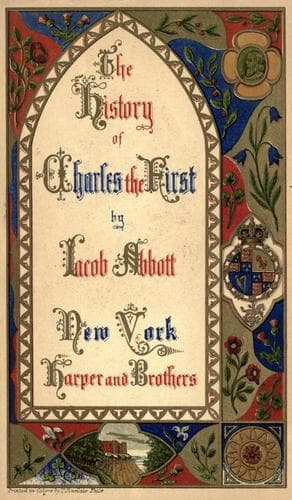
History of King Charles the First of EnglandAbbott, Jacob
History
History of King Charles the First of England
Abbott, Jacob
Charles I, King of England, 1600-1649; Great Britain -- History -- Charles I, 1625-1649; Great Britain -- Kings and rulers -- Biography
The result was quite as disastrous as James feared. Frederic not only
failed of getting his new kingdom, but he provoked the rage of the
Catholic powers against whom he had undertaken to contend, and they
poured a great army into his own original territory, and made an easy
conquest of it. Frederic fled to Holland, and remained there a fugitive
and an exile, hoping to obtain help in some way from James, in his
efforts to recover his lost dominions.
The people of England felt a great interest in Frederic's unhappy
fate, and were very desirous that James should raise an army and give
him some efficient assistance. One reason for this was that they were
Protestants, and they were always ready to embark, on the Protestant
side, in the Continental quarrels.
[Sidenote: Elizabeth.]
Another reason was their interest in Elizabeth, the wife of Frederic,
who had so recently left England a blooming bride, and whom they
still considered as in some sense pertaining to the royal family of
England, and as having a right to look to all her father's subjects for
protection.
[Sidenote: James's plan.]
[Sidenote: Donna Maria.]
But King James himself had no inclination to go to war in such a
quarrel. He was inactive in mind, and childish, and he had little
taste for warlike enterprises. He undertook, however, to accomplish
the object in another way. The King of Spain, being one of the most
powerful of the Catholic sovereigns, had great influence in all their
councils. He had also a beautiful daughter, Donna Maria, called, as
Spanish princesses are styled, the Infanta. Now James conceived the
design of proposing that his son Charles should marry Donna Maria,
and that, in the treaty of marriage, there should be a stipulation
providing that the Palatinate should be restored to Frederic.
[Sidenote: Negotiations with Spain.]
These negotiations were commenced, and they went on two or three years
without making any sensible progress. Donna Maria was a Catholic, and
Charles a Protestant. Now a Catholic could not marry a Protestant
without a special dispensation from the pope. To get this dispensation
required new negotiations and delays. In the midst of it all, the King
of Spain, Donna Maria's father, died, and his son, her brother, named
Philip, succeeded him. Then the negotiations had all to be commenced
anew. It was supposed that the King of Spain did not wish to have the
affair concluded, but liked to have it in discussion, as it tended to
keep the King of England more or less under his control.
[Sidenote: Obstacles and delays.]
Public-domain text, read in full here on John Shaqi.
Reviews
Reviews
No reviews yet
Be the first to share your thoughts on this work.
Join the Discussion
Join the discussion
Sign in to leave a comment or review.
Sign InorCreate an account