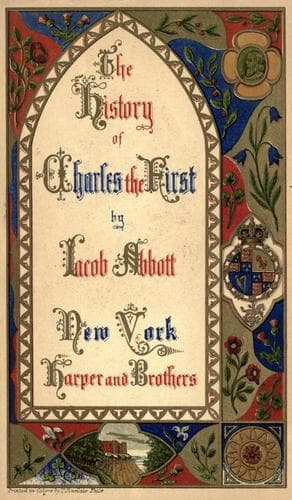
History of King Charles the First of EnglandAbbott, Jacob
History
History of King Charles the First of England
Abbott, Jacob
Charles I, King of England, 1600-1649; Great Britain -- History -- Charles I, 1625-1649; Great Britain -- Kings and rulers -- Biography
He spent his time, during this long period, in various pursuits
calculated to beguile the weary days, and he sometimes planned schemes
for escape. There were also a great many messages and negotiations
going between the king and the Parliament, which resulted in nothing
but to make the breach between them wider and wider. Sometimes the
king was silent and depressed. At other times he seemed in his usual
spirits. He read serious books a great deal, and wrote. There is a
famous book, which was found in manuscript after his death among his
papers, in his handwriting, which it is supposed he wrote at this time.
He was allowed to take walks upon the castle wall, which was very
extensive, and he had some other amusements which served to occupy his
leisure time. He found his confinement, however, in spite of all these
mitigations, wearisome and hard to bear.
There were some schemes attempted to enable him to regain his liberty.
There was one very desperate attempt. It seems that Hammond, suspecting
that the king was plotting an escape, dismissed the king's own
servants and put others in their places--persons in whom he supposed
he could more implicitly rely. One of these men, whose name was Burley,
was exasperated at being thus dismissed. He went through the town
of Carisbrooke, beating a drum, and calling upon the people to rise
and rescue their sovereign from his captivity. The governor of the
castle, hearing of this, sent out a small body of men, arrested Burley,
and hanged and quartered him. The king was made a close prisoner
immediately after this attempt.
[Sidenote: Unsuccessful attempts to escape.]
[Sidenote: Osborne.]
Notwithstanding this, another attempt was soon made by the king
himself, which came much nearer succeeding. There was a man by the name
of Osborne, whom Hammond employed as a personal attendant upon the
king. He was what was called gentleman usher. The king succeeded in
gaining this person's favor so much by his affability and his general
demeanor, that one day he put a little paper into one of the king's
gloves, which it was a part of his office to hold on certain occasions,
and on this paper he had written that he was at the king's service.
At first Charles was afraid that this offer was only a treacherous
one; but at length he confided in him. In the mean time, there was
a certain man by the name of Rolf in the garrison, who conceived the
design of enticing the king away from the castle on the promise of
promoting his escape, and then murdering him. Rolf thought that this
plan would please the Parliament, and that he himself, and those who
should aid him in the enterprise, would be rewarded. He proposed this
scheme to Osborne, and asked him to join in the execution of it.
[Sidenote: Plan of escape.]
[Sidenote: Rolf's treacherous design.]
Public-domain text, read in full here on John Shaqi.
Reviews
Reviews
No reviews yet
Be the first to share your thoughts on this work.
Elsewhere in the archive
Join the Discussion
Join the discussion
Sign in to leave a comment or review.
Sign InorCreate an account