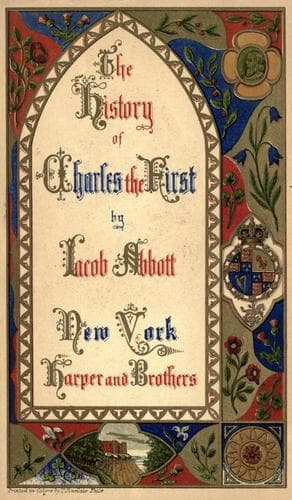
History of King Charles the First of EnglandAbbott, Jacob
History
History of King Charles the First of England
Abbott, Jacob
Charles I, King of England, 1600-1649; Great Britain -- History -- Charles I, 1625-1649; Great Britain -- Kings and rulers -- Biography
Osborne made the whole plan known to the king. The king, on reflection,
said to Osborne, "Very well; continue in communication with Rolf,
and help him mature his plan. Let him thus aid in getting me out of
the castle, and we will make such arrangements as to prevent the
assassination." Osborne did so. He also gained over some other soldiers
who were employed as sentinels near the place of escape. Osborne and
Rolf furnished the king with a saw and a file, by means of which he
sawed off some iron bars which guarded one of his windows. They were
then, on a certain night, to be ready with a few attendants on the
outside to receive the king as he descended, and convey him away.
[Sidenote: Rolf foiled.]
[Sidenote: The king made a closer prisoner.]
In the mean time, Rolf and Osborne had each obtained a number of
confederates, those of the former supposing that the plan was to
assassinate the king, while those of the latter understood that the
plan was to assist him in escaping from captivity. Some expressions
which were dropped by one of this latter class alarmed Rolf, and led
him to suspect some treachery. He accordingly took the precaution to
provide a number of armed men, and to have them ready at the window,
so that he should be sure to be strong enough to secure the king
immediately on his descent from the window. When the time came for the
escape, the king, before getting out, looked below, and, seeing so many
armed men, knew at once that Rolf had discovered their designs, and
refused to descend. He quickly returned to his bed. The next day the
bars were found filed in two, and the king was made a closer prisoner
than ever.
[Sidenote: The king's wretched condition.]
Some months after this, some commissioners from Parliament went to see
the king, and they found him in a most wretched condition. His beard
was grown, his dress was neglected, his health was gone, his hair
was gray, and, though only forty-eight years of age, he appeared as
decrepit and infirm as a man of seventy. In fact, he was in a state
of misery and despair. Even the enemies who came to visit him, though
usually stern and hard-hearted enough to withstand any impressions,
were extremely affected at the sight.
CHAPTER XI.
TRIAL AND DEATH.
[Sidenote: The king removed to Hurst Castle.]
Public-domain text, read in full here on John Shaqi.
Reviews
Reviews
No reviews yet
Be the first to share your thoughts on this work.
Elsewhere in the archive
Join the Discussion
Join the discussion
Sign in to leave a comment or review.
Sign InorCreate an account