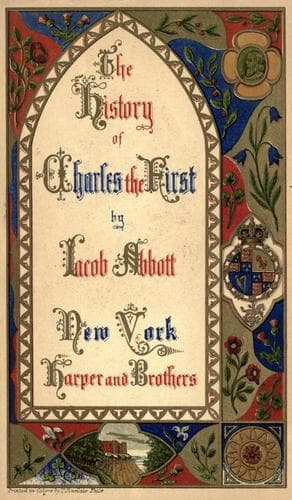
History of King Charles the First of EnglandAbbott, Jacob
History
History of King Charles the First of England
Abbott, Jacob
Charles I, King of England, 1600-1649; Great Britain -- History -- Charles I, 1625-1649; Great Britain -- Kings and rulers -- Biography
As soon as the army party, with Oliver Cromwell at their head, had
obtained complete ascendency, they took immediate measures for
proceeding vigorously against the king. They seized him at Carisbrooke
Castle, and took him to Hurst Castle, which was a gloomy fortress
in the neighborhood of Carisbrooke. Hurst Castle was in a very
extraordinary situation. There is a long point extending from the main
land toward the Isle of Wight, opposite to the eastern end of it. This
point is very narrow, but is nearly two miles long. The castle was
built at the extremity. It consisted of one great round tower, defended
by walls and bastions. It stood lonely and desolate, surrounded by
the sea, except the long and narrow neck which connected it with the
distant shore. Of course, though comfortless and solitary, it was a
place of much greater security than Carisbrooke.
[Sidenote: Its extraordinary situation.]
[Sidenote: Another plan of escape.]
[Sidenote: Objections.]
The circumstance of the king's removal to this new place of
confinement were as follows: In some of his many negotiations with
the Parliament while at Carisbrooke, he had bound himself, on certain
conditions, not to attempt to escape from that place. His friends,
however, when they heard that the army were coming again to take him
away, concluded that he ought to lose no time in making his escape
out of the country. They proposed the plan to the king. He made two
objections to it. He thought, in the first place, that the attempt
would be very likely to fail; and that, if it did fail, it would
exasperate his enemies, and make his confinement more rigorous, and his
probable danger more imminent than ever. He said that, in the second
place, he had promised the Parliament that he would not attempt to
escape, and that he could not break his word.
The three friends were silent when they heard the king speak these
words. After a pause, the leader of them, Colonel Cook, said,
"Suppose I were to tell your majesty that the army have a plan for
seizing you immediately, and that they will be upon you very soon
unless you escape. Suppose I tell you that we have made all the
preparations necessary--that we have horses all ready here, concealed
in a pent-house--that we have a vessel at the Cows[7] waiting for
us--that we are all prepared to attend you, and eager to engage in the
enterprise--the darkness of the night favoring our plan, and rendering
it almost certain of success. Now," added he, "these suppositions
express the real state of the case, and the only question is what your
majesty will resolve to do."
[7] There were two points or headlands, on opposite sides of an
inlet from the sea, on the northern side of the Isle of Wight, which
in ancient times received the name of _Cows_. They were called the
East Cow and the West Cow. The harbor between them formed a safe and
excellent harbor. The name is now spelled Cowes, and the port is, at
the present day, of great commercial importance.
Public-domain text, read in full here on John Shaqi.
Reviews
Reviews
No reviews yet
Be the first to share your thoughts on this work.
Elsewhere in the archive
Join the Discussion
Join the discussion
Sign in to leave a comment or review.
Sign InorCreate an account