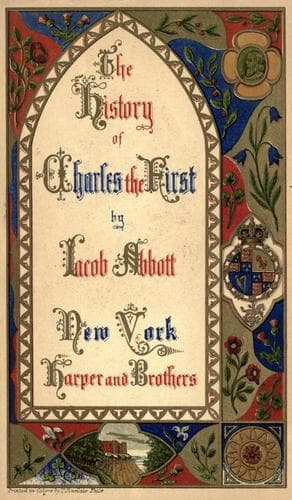
History of King Charles the First of EnglandAbbott, Jacob
History
History of King Charles the First of England
Abbott, Jacob
Charles I, King of England, 1600-1649; Great Britain -- History -- Charles I, 1625-1649; Great Britain -- Kings and rulers -- Biography
He repented, however, as soon as the consent was given, and when
Charles and Buckingham came next to see him, he said it must be given
up. One great source of his anxiety was a fear that his son might be
taken and kept a prisoner, either in France or Spain, and detained
a long time in captivity. Such a captive was always, in those days,
a very tempting prize to a rival power. Personages of very high rank
may be detained as captives, while all the time those who detain them
may pretend not to confine them at all, the guards and sentinels being
only marks of regal state, and indications of the desire of the power
into whose hands they have fallen to treat them in a manner comporting
with their rank. Then there were always, in those days, questions and
disputes pending between the rival courts of England, France, and
Spain, out of which it was easy to get a pretext for detaining any
strolling prince who might cross the frontier, as security for the
fulfillment of some stipulation, or for doing some act of justice
claimed. James, knowing well how much faith and honor were to be
expected of kings and courts, was afraid to trust his son in French or
Spanish dominions. He said he certainly could not consent to his going,
without first sending to _France_, at least, for a safe-conduct--that
is, a paper from the government, pledging the honor of the king not to
molest or interrupt him in his journey through his dominions.
[Sidenote: Buckingham's violence.]
Buckingham, instead of attempting to reassure the king by fresh
arguments and persuasions, broke out into a passion, accused him of
violating his promise not to reveal their plan to any one, as he knew,
he said, that this new opposition had been put into his head by some of
his counselors to whom he had made known the design. The king denied
this, and was terrified, agitated, and distressed by Buckingham's
violence. He wept like a child. His opposition at length gave way a
second time, and he said they might go. They named two attendants
whom they wanted to go with them. One was an officer of the king's
household, named Collington, who was then in the anteroom. They asked
the king to call him in to see if he would go. When Collington came in,
the king accosted him with, "Here's Steeny and Baby Charley that want
to go to Spain and fetch the Infanta. What think you of it?" Collington
did not think well of it at all.
[Sidenote: Angry disputes.]
There followed a new relapse on the part of the king from his consent,
a new storm of anger from Buckingham, more sullen obstinacy on the part
of Charles, with profane criminations and recriminations one against
another. The whole scene was what, if it had occurred any where else
than in a palace, would have been called a brawl.
[Sidenote: James's distress.]
Public-domain text, read in full here on John Shaqi.
Reviews
Reviews
No reviews yet
Be the first to share your thoughts on this work.
Join the Discussion
Join the discussion
Sign in to leave a comment or review.
Sign InorCreate an account