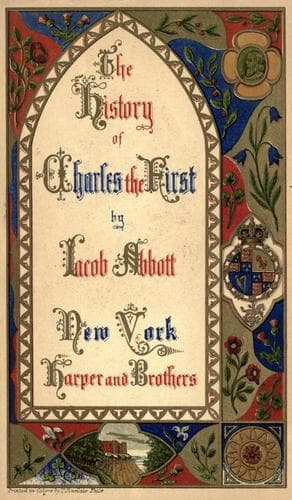
History of King Charles the First of England — John Shaqi
History of King Charles the First of EnglandAbbott, Jacob
History
History of King Charles the First of England
Abbott, Jacob
Charles I, King of England, 1600-1649; Great Britain -- History -- Charles I, 1625-1649; Great Britain -- Kings and rulers -- Biography
On landing at Calais, they traveled post to Paris, strictly preserving
their incognito, but assuming such an air and bearing as to create the
impression that they were not what they pretended. When they reached
Paris, Buckingham could not resist the temptation of showing Charles a
little of life, and he contrived to get admitted to a party at court,
where Charles saw, among other ladies who attracted his attention,
the Princess Henrietta. He was much struck with her beauty and grace,
but he little thought that it was this princess, and not the Infanta
whom he was going in pursuit of, who was really to become his wife, and
the future Queen of England.
[Sidenote: Bourdeaux.]
The young travelers thought it not prudent to remain long in Paris,
and they accordingly left that city, and pressed forward as rapidly
as possible toward the Spanish frontier. They managed, however, to
conduct always in such a way as to attract attention. Although they
were probably sincerely desirous of not having their true rank and
character known, still they could not resist the temptation to assume
such an air and bearing as to make people wonder who they were, and
thus increase the spirit and adventure of their journey. At Bourdeaux
they received invitations from some grandees to be present at some
great gala, but they declined, saying that they were only poor
gentlemen traveling to inform their minds, and were not fit to appear
in such gay assemblies.
[Sidenote: Entrance into Madrid.]
At last they approached Madrid. They had, besides Collington, another
attendant who spoke the Spanish language, and served them as an
interpreter. They separated from these two the day before they entered
Madrid, so as to attract the less attention. Their attendants were to
be left behind for a day, and afterward were to follow them into the
city. The name of the British embassador at Madrid was the Earl of
Bristol. He had had charge of all the negotiations in respect to the
marriage, and to the restoration of the Palatinate, and believed that
he had brought them almost to a successful termination. He lived in a
palace in Madrid, and, as is customary with the embassadors of great
powers at the courts of great powers, in a style of the highest pomp
and splendor.
[Sidenote: Bristol's amazement.]
[Sidenote: Charles's reception.]
Buckingham took the prince directly to Bristol's house. Bristol was
utterly confounded at seeing them. Nothing could be worse, he said, in
respect to the completion of the treaty, than the prince's presence in
Madrid. The introduction of so new and extraordinary an element into
the affair would undo all that had been done, and lead the King of
Spain to begin anew, and go over all the ground again. In speaking of
this occurrence to another, he said that just as he was on the point of
coming to a satisfactory conclusion of his long negotiations and toils,
a demon in the shape of Prince Charles came suddenly upon the stage to
thwart and defeat them all.
Public-domain text, read in full here on John Shaqi.
Reviews
Reviews
No reviews yet
Be the first to share your thoughts on this work.
Join the Discussion
Join the discussion
Sign in to leave a comment or review.
Sign InorCreate an account