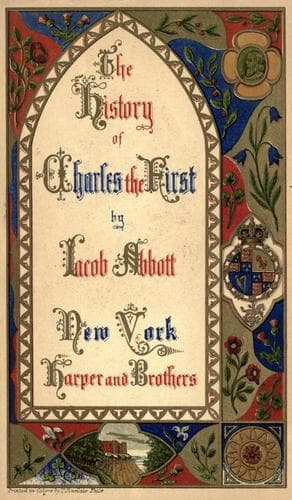
History of King Charles the First of EnglandAbbott, Jacob
History
History of King Charles the First of England
Abbott, Jacob
Charles I, King of England, 1600-1649; Great Britain -- History -- Charles I, 1625-1649; Great Britain -- Kings and rulers -- Biography
True, the farmer would reply; but in matters of government we are to
consider what will promote the general good. The great object to be
attained is the welfare and happiness of the community. Now, if this
general welfare comes into competition with the supposed rights of
individuals, arising from such a principle as hereditary succession,
the latter ought certainly to yield.
[Sidenote: Property and prerogatives.]
[Sidenote: Hereditary succession an absolute right.]
But why, might the lawyer reply, should rights founded on hereditary
succession yield any more readily in the case of _government_ than in
the case of _property_? The distribution of property influences the
general welfare quite as much as the management of power. Suppose it
were proved that the general welfare of your parish would be promoted
by the division of your land among the destitute there. You have
nothing to oppose to such a proposition but your hereditary right.
And the king has that to oppose to any plan of a division of his
prerogatives and powers among the people who would like to share them.
Whatever may be thought of this reasoning on this side of the Atlantic,
and at the present day, it was considered very satisfactory in England
two or three centuries ago. The true and proper jurisdiction of an
English monarch, as it had existed from ancient times, was considered
as an _absolute right_, vesting in each successive inheritor of the
crown, and which the community could not justly interfere with or
disturb for any reasons less imperious than such as would authorize an
interference with the right of succession to private property. Indeed,
it is probable that, with most men at that time, an inherited right to
_govern_ was regarded as the most sacred of the two.
[Sidenote: Three things hereditary in England.]
The fact seems to be, that the right of a son to come into the place
of his father, whether in respect to property, power, or social rank,
is not a natural, inherent, and indefeasible right, but a _privilege_
which society accords, as a matter of convenience and expediency. In
England, expediency is, on the whole, considered to require that all
three of these things, viz., property, rank, and power, in certain
cases, should descend from father to son. In this country, on the other
hand, we confine the hereditament to property, abrogating it in the
case of rank and power. In neither case is there probably any absolute
natural right, but a conventional right is allowed to take its place in
one, or another, or all of these particulars, according to the opinion
of the community in respect to what its true interests and the general
welfare, on the whole, require.
[Sidenote: The Stuarts.]
Public-domain text, read in full here on John Shaqi.
Reviews
Reviews
No reviews yet
Be the first to share your thoughts on this work.
Join the Discussion
Join the discussion
Sign in to leave a comment or review.
Sign InorCreate an account