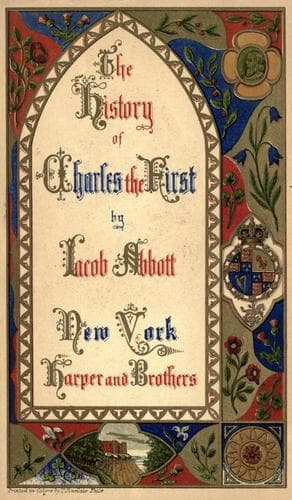
History of King Charles the First of EnglandAbbott, Jacob
History
History of King Charles the First of England
Abbott, Jacob
Charles I, King of England, 1600-1649; Great Britain -- History -- Charles I, 1625-1649; Great Britain -- Kings and rulers -- Biography
Every thing, however, was done in the king's _name_. The ships were his
majesty's ships, the admirals were his majesty's servants, the war was
his majesty's war, the court was the _King's_ Bench. The idea was, that
all these thousands of officers, of all ranks and grades, were only an
enormous multiplication of his majesty; that they might do his will
and carry on his administration as he would himself carry it on were
he personally capable of attending to such a vast detail; subject, of
course, to certain limits and restrictions which the laws and customs
of the realm, and the promises and contracts of his predecessors, had
imposed. But although all this action was theoretically the king's
action, it came to be, in fact, almost wholly independent of him. It
went on of itself, in a regular and systematic way, pursuing its own
accustomed course, except so far as the king directly interposed to
modify its action.
It might be supposed that the king would certainly take _the general
direction_ of affairs into his own hands, and that this charge, at
least, would necessarily come upon him, as king, day by day. Some
monarchs have attempted to do this, but it is obvious that there must
be some provision for having this general charge, as well as all the
subordinate functions of government, attended to independently of the
king, as his being always in a condition to fulfill this duty is not
to be relied upon. Sometimes the king is young and inexperienced;
sometimes he is sick or absent; and sometimes he is too feeble in
mind, or too indolent, or too devoted to his pleasures to exercise any
governmental care. There has gradually grown up, therefore, in all
monarchies, the custom of having a central board of officers of state,
whom the king appoints, and who take the general direction of affairs
off his mind, except so far as he chooses to interfere. This board, in
England, is called the Privy Council.
[Sidenote: The Privy Council.]
[Sidenote: It represents the king.]
[Sidenote: Constitution and functions of the Privy Council.]
Public-domain text, read in full here on John Shaqi.
Reviews
Reviews
No reviews yet
Be the first to share your thoughts on this work.
Join the Discussion
Join the discussion
Sign in to leave a comment or review.
Sign InorCreate an account