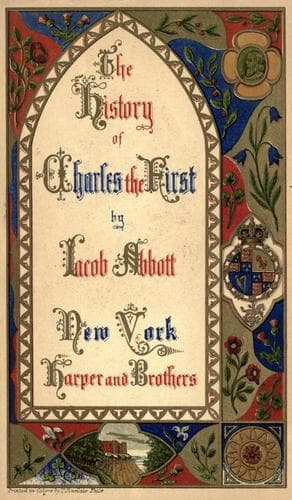
History of King Charles the First of EnglandAbbott, Jacob
History
History of King Charles the First of England
Abbott, Jacob
Charles I, King of England, 1600-1649; Great Britain -- History -- Charles I, 1625-1649; Great Britain -- Kings and rulers -- Biography
The Privy Council in England is a body of great importance. Its nature
and its functions are, of course, entirely different from those of
the two houses of Parliament. _They_ represent, or are intended to
represent, the nation. The Parliament is, in theory, the nation,
assembled at the king's command, to give him their advice. The Privy
Council, on the other hand, represents the king. It is the king's
Privy Council. They act in his name. They follow his directions when
he chooses to give any. Whatever they decide upon and decree, the king
signs--often, indeed, without any idea of what it is; but he still
signs it, and all such decrees go forth to the world as the king's
orders in council. The Privy Council, of course, would have its
meetings, its officers, its records, its rules of proceeding, and its
various usages, and these grew, in time, to be laws and rights; but
still it was, in theory, only a sort of expansion of the king, as if
to make a kind of artificial being, with one soul, but many heads and
hands, because no natural human being could possibly have capacities
and powers extensive and multifarious enough for the exigencies of
reigning. Charles thus had a council who went on with every thing,
except so far as he chose to interpose. The members were generally able
and experienced men. And yet Buckingham was among them. He had been
made Lord High Admiral of England, which gave him supreme command of
the navy, and admitted him to the Privy Council. These were very high
honors.
This Privy Council now took the direction of public affairs, attended
to every thing, provided for all emergencies, and kept all the
complicated machinery of government in motion, without the necessity
of the king's having any personal agency in the matter. The king might
interpose, more or less, as he was inclined; and when he did interpose,
he sometimes found obstacles in the way of immediately accomplishing
his plans, in the forms or usages which had gradually grown into laws.
[Sidenote: Restrictions on the royal power.]
[Sidenote: A new Parliament.]
For instance, when the king began his reign, he was very eager to have
the war for the recovery of the Palatinate go on at once; and he was,
besides, very much embarrassed for want of money. He wished, therefore,
in order to save time, that the old Parliament which King James had
called should continue to act under his reign. But his Privy Council
told him that that could not be. That was _James's_ Parliament. If he
wanted one for his reign, he must call upon the people to elect a new
Parliament for him.
Public-domain text, read in full here on John Shaqi.
Reviews
Reviews
No reviews yet
Be the first to share your thoughts on this work.
Join the Discussion
Join the discussion
Sign in to leave a comment or review.
Sign InorCreate an account