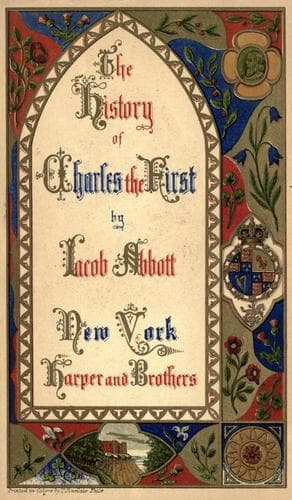
History of King Charles the First of England — John Shaqi
History of King Charles the First of EnglandAbbott, Jacob
History
History of King Charles the First of England
Abbott, Jacob
Charles I, King of England, 1600-1649; Great Britain -- History -- Charles I, 1625-1649; Great Britain -- Kings and rulers -- Biography
The new Parliament was called, and Charles sent them a very civil
message, explaining the emergency which had induced him to call them,
and the reason why he was so much in want of money. His father had left
the government a great deal in debt. There had been heavy expenses
connected with the death of the former king, and with his own accession
and marriage. Then there was the war. It had been engaged in by his
father, with the approbation of the former Parliament; and engagements
had been made with allies, which now they could not honorably retract.
He urged them, therefore, to grant, without delay, the necessary
supplies.
[Sidenote: The new Parliament meets at Oxford.]
The Parliament met in July, but the plague was increasing in London,
and they had to adjourn, early in August, to Oxford. This city is
situated upon the Thames, and was then, as it is now, the seat of a
great many colleges. These colleges were independent of each other
in their internal management, though united together in one general
system. The name of one of them, which is still very distinguished,
was Christ Church College. They had, among the buildings of that
college, a magnificent hall, more than one hundred feet long, and very
lofty, built in a very imposing style. It is still a great object of
interest to all who visit Oxford. This hall was fitted up for the use
of Parliament, and the king met the two houses there, and made a new
speech himself, and had others made by his ministers, explaining the
state of public affairs, and gently urging the houses to act with
promptness and decision.
[Sidenote: Difficulties commence between the king and Parliament.]
[Sidenote: Demands of Parliament, and the king's answers.]
The houses then separated, and each commenced its own deliberations.
But, instead of promptly complying with the king's proposals, they
sent him a petition for redress of a long list of what they called
grievances. These grievances were, almost all of them, complaints
of the toleration and encouragement of the Catholics, through the
influence of the king's Catholic bride. She had stipulated to have a
Catholic chapel, and Catholic attendants, and, after her arrival in
England, she and Buckingham had so much influence over the king, that
they were producing quite a change at court, and gradually through all
ranks of society, in favor of the Catholics. The Commons complained of
a great many things, nearly all, however, originating in this cause.
The king answered these complaints, clause by clause, promising redress
more or less distinctly. There is not room to give this petition and
the answers in full, but as all the subsequent troubles between Charles
and the people of England arose out of this difficulty of his young
wife's bringing in so strong a Catholic influence with her to the
realm, it may be well to give an abstract of some of the principal
petitions, with the king's answers.
The Commons said
Public-domain text, read in full here on John Shaqi.
Reviews
Reviews
No reviews yet
Be the first to share your thoughts on this work.
Join the Discussion
Join the discussion
Sign in to leave a comment or review.
Sign InorCreate an account