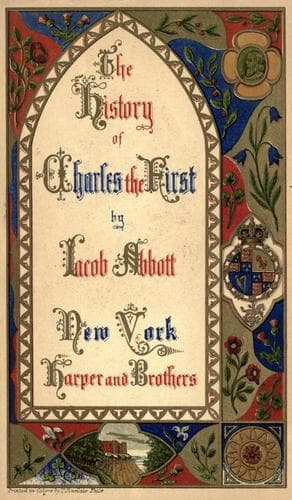
History of King Charles the First of England — John Shaqi
History of King Charles the First of EnglandAbbott, Jacob
History
History of King Charles the First of England
Abbott, Jacob
Charles I, King of England, 1600-1649; Great Britain -- History -- Charles I, 1625-1649; Great Britain -- Kings and rulers -- Biography
The above are sufficient for a specimen of these complaints and of the
king's answers. There were many more of them, but they have all the
same character and end, namely, to stop the strong current of Catholic
influence and ascendency which was setting in to the court, and through
the court into the realm, through the influence of the young queen
and the persons connected with her. At the present day, and in this
country, the Commons will be thought to be in the wrong, inasmuch as
the thing which they were contending against was, in the main, merely
the toleration of the Catholic religion. But then the king was in the
wrong too, for, since the laws against this toleration stood enacted
by the consent and concurrence of his predecessors, he should not
have allowed them to be infracted and virtually annulled through the
influence of a foreign bride and an unworthy favorite.
[Sidenote: The king promises every thing.]
[Sidenote: His insincerity.]
Perhaps he felt that he was wrong, or perhaps his answers were all
framed for him by his Privy Council. At all events, they were entirely
favorable to the demands of the Commons. He promised every thing. In
many things he went even beyond their demands. It is admitted, however,
on all hands, that, so far as he himself had any agency in making these
replies, he was not really sincere. He himself, and Buckingham, were
very eager to get supplies. Buckingham was admiral of the fleet, and
had a great desire to enlarge the force at his command, with a view
to the performing of some great exploit in the war. It is understood,
therefore, that the king intended his replies as promises merely. At
any rate, the promises were made. The Commons were called into the
great hall again, at Christ Church, where the Peers assembled, and the
king's answers were read to them. Buckingham joined in this policy
of attempting to conciliate the Commons. He went into their assembly
and made a long speech, explaining and justifying his conduct, and
apologizing, in some sense, for what might seem to be wrong.
[Sidenote: Commons not satisfied.]
[Sidenote: Parliament dissolved.]
Public-domain text, read in full here on John Shaqi.
Reviews
Reviews
No reviews yet
Be the first to share your thoughts on this work.
Join the Discussion
Join the discussion
Sign in to leave a comment or review.
Sign InorCreate an account