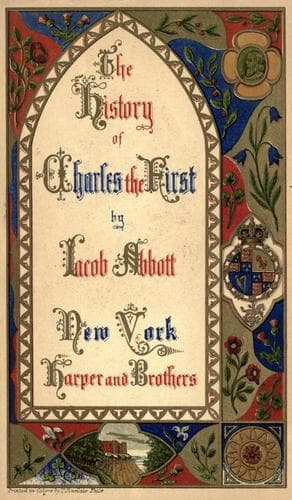
History of King Charles the First of EnglandAbbott, Jacob
History
History of King Charles the First of England
Abbott, Jacob
Charles I, King of England, 1600-1649; Great Britain -- History -- Charles I, 1625-1649; Great Britain -- Kings and rulers -- Biography
In those early days there was a prevailing belief in Scotland, and,
in fact, the opinion still lingers there, that certain persons among
the old Highlanders had what they called the gift of the second
sight--that is, the power of foreseeing futurity in some mysterious
and incomprehensible way. An incident is related in the old histories
connected with Charles's infancy, which is a good illustration of this.
While King James was preparing to leave Scotland, to take possession
of the English throne, an old Highland laird came to bid him farewell.
He gave the king many parting counsels and good wishes, and then,
overlooking the older brother, Prince Henry, he went directly to
Charles, who was then about two years old, and bowed before him, and
kissed his hand with the greatest appearance of regard and veneration.
King James undertook to correct his supposed mistake, by telling him
that that was his second son, and that the other boy was the heir
to the crown. "No," said the old laird, "I am not mistaken. I know
to whom I am speaking. This child, now in his nurse's arms, will be
greater than his brother. This is the one who is to convey his father's
name and titles to succeeding generations." This prediction was
fulfilled; for the robust and healthy Henry died, and the feeble and
sickly-looking Charles lived and grew, and succeeded, in due time, to
his father's throne.
[Sidenote: An explanation.]
Now inasmuch as, at the time when this prediction was uttered, there
seemed to be little human probability of its fulfillment, it attracted
attention; its unexpected and startling character made every one notice
and remember it; and the old laird was at once an object of interest
and wonder. It is probable that this desire to excite the admiration
of the auditors, mingled insensibly with a sort of poetic enthusiasm,
which a rude age and mountainous scenery always inspires, was the
origin of a great many such predictions as these; and then, in the end,
those only which turned out to be true were remembered, while the rest
were forgotten; and this was the way that the reality of such prophetic
powers came to be generally believed in.
[Sidenote: Charles's titles of nobility.]
Feeble and uncertain of life as the infant Charles appeared to be,
they conferred upon him, as is customary in the case of young princes,
various titles of nobility. He was made a duke, a marquis, an earl,
and a baron, before he had strength enough to lift up his head in his
nurse's arms. His title as duke was Duke of Albany; and as this was
the highest of his nominal honors, he was generally known under that
designation while he remained in Scotland.
[Illustration: WINDSOR CASTLE.]
[Sidenote: Charles's governess.]
Public-domain text, read in full here on John Shaqi.
Reviews
Reviews
No reviews yet
Be the first to share your thoughts on this work.
Join the Discussion
Join the discussion
Sign in to leave a comment or review.
Sign InorCreate an account