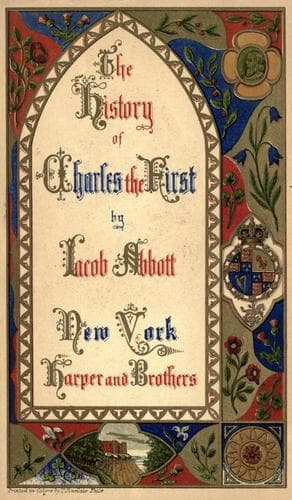
History of King Charles the First of EnglandAbbott, Jacob
History
History of King Charles the First of England
Abbott, Jacob
Charles I, King of England, 1600-1649; Great Britain -- History -- Charles I, 1625-1649; Great Britain -- Kings and rulers -- Biography
In a civil war, however, it is very different. Every distinct portion
of the country, every village and hamlet, and sometimes almost every
family, is divided against itself. The hostility and hatred, too,
between the combatants, is always far more intense and bitter than that
which is felt against a foreign foe. We might at first be surprised
at this. We might imagine that where men are contending with their
neighbors and fellow-townsmen, the recollection of past friendships
and good-will, and various lingering ties of regard, would moderate
the fierceness of their anger, and make them more considerate and
forbearing. But this is not found to be the case. Each party considers
the other as not only enemies, but traitors, and accordingly they hate
and abhor each other with a double intensity. If an Englishman has a
_Frenchman_ to combat, he meets him with a murderous impetuosity, it
is true, but without any special bitterness of animosity. He _expects_
the Frenchman to be his enemy. He even thinks he has a sort of natural
right to be so. He will kill him if he can; but then, if he takes him
prisoner, there is nothing in his feelings toward him to prevent his
treating him with generosity, and even with kindness. He hates him,
but there is a sort of good-nature in his hatred, after all. On the
other hand, when he fights against his countrymen in a civil war, he
abhors and hates with unmingled bitterness the traitorous ingratitude
which he thinks his neighbors and friends evince in turning enemies to
their country. He can see no honesty, no truth, no courage in any thing
they do. They are infinitely worse, in his estimation, than the most
ferocious of foreign foes. Civil war is, consequently, always the means
of far wider and more terrible mischief than any other human calamity.
[Sidenote: Taking sides between the king and Parliament.]
In the contention between Charles and the Parliament, the various
elements of the social state adhered to one side or the other,
according to their natural predilections. The Episcopalians generally
joined the king, the Presbyterians the Parliament. The gentry and the
nobility favored the king; the mechanics, artisans, merchants, and
common people the Parliament. The rural districts of country, which
were under the control of the great landlords, the king; the cities and
towns, the Parliament. The gay, and fashionable, and worldly, the king;
the serious-minded and austere, the Parliament. Thus every thing was
divided. The quarrel ramified to every hamlet and to every fireside,
and the peace and happiness of the realm were effectually destroyed.
[Sidenote: Preparations for war.]
[Sidenote: Fruitless negotiations.]
Public-domain text, read in full here on John Shaqi.
Reviews
Reviews
No reviews yet
Be the first to share your thoughts on this work.
Elsewhere in the archive
Join the Discussion
Join the discussion
Sign in to leave a comment or review.
Sign InorCreate an account