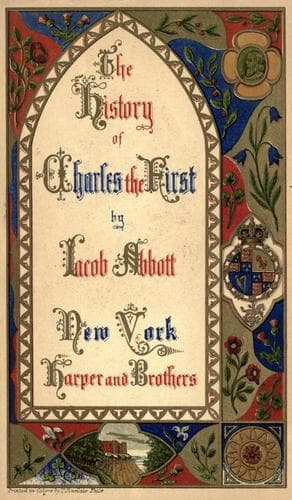
History of King Charles the First of EnglandAbbott, Jacob
History
History of King Charles the First of England
Abbott, Jacob
Charles I, King of England, 1600-1649; Great Britain -- History -- Charles I, 1625-1649; Great Britain -- Kings and rulers -- Biography
Both sides began to raise armies and to prepare for war. Before
commencing hostilities, however, the king was persuaded by his
counselors to send a messenger to London and propose some terms of
accommodation. He accordingly sent the Earl of Southampton to the
House of Peers, and two other persons to the House of Commons. He
had no expectation, probably, of making peace, but he wanted to gain
time to get his army together, and also to strengthen his cause among
the people by showing a disposition to do all in his power to avoid
open war. The messengers of the king went to London, and made their
appearance in the two houses of Parliament.
The House of Lords ordered the Earl of Southampton to withdraw, and to
send his communication in in writing, and in the mean time to retire
out of London, and wait for their answer. The House of Commons, in the
same spirit of hostility and defiance, ordered the messengers which
had been sent to them to come to the bar, like humble petitioners or
criminals, and make their communication there.
The propositions of the king to the houses of Parliament were, that
they should appoint a certain number of commissioners, and he also the
same number, to meet and confer together, in hope of agreeing upon
some conditions of peace. The houses passed a vote in reply, declaring
that they had been doing all in their power to preserve the peace of
the kingdom, while the king had been interrupting and disturbing it
by his military gatherings, and by proclamations, in which they were
called traitors; and that they could enter into no treaty with him
until he disbanded the armies which he had collected, and recalled his
proclamations.
[Sidenote: Messages between the king and Parliament.]
To this the king replied that he had never intended to call them
traitors; and that when they would recall their declarations and votes
stigmatizing those who adhered to him as traitors, he would recall
his proclamations. Thus messages passed back and forth two or three
times, each party criminating the other, and neither willing to make
the concessions which the other required. At last all hope of an
accommodation was abandoned, and both sides prepared for war.
[Sidenote: 1643.]
[Sidenote: Ravages of the war.]
The nobility and gentry flocked to the king's standard. They brought
their plate, their jewels, and their money to provide funds. Some of
them brought their servants. There were two companies in the king's
guard, one of which consisted of gentlemen, and the other of their
servants. These two companies were always kept together. There was the
greatest zeal and enthusiasm among the upper classes to serve the king,
and equal zeal and enthusiasm among the common people to serve the
Parliament. The war continued for four years. During all this time the
armies marched and countermarched all over the kingdom, carrying ruin
and destruction wherever they went, and plunging the whole country in
misery.
Public-domain text, read in full here on John Shaqi.
Reviews
Reviews
No reviews yet
Be the first to share your thoughts on this work.
Elsewhere in the archive
Join the Discussion
Join the discussion
Sign in to leave a comment or review.
Sign InorCreate an account