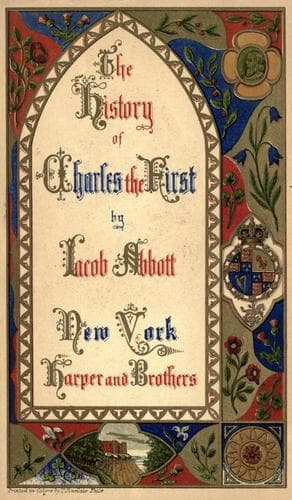
History of King Charles the First of EnglandAbbott, Jacob
History
History of King Charles the First of England
Abbott, Jacob
Charles I, King of England, 1600-1649; Great Britain -- History -- Charles I, 1625-1649; Great Britain -- Kings and rulers -- Biography
[Illustration: THE KING'S ADHERENTS ENTERING YORK.]
[Sidenote: Death of Hampden.]
At one of the battles which was fought, the celebrated John Hampden,
the man who would not pay his ship money, was slain. He had been a very
energetic and efficient officer on the Parliamentary side, and was
much dreaded by the forces of the king. At one of the battles between
Prince Rupert, Charles's nephew, and the army of the Parliament, the
prince brought to the king's camp a large number of prisoners which
he had taken. One of the prisoners said he was confident that Hampden
was hurt, for he saw him riding off the field before the battle was
over, with his head hanging down, and his hands clasping the neck of
his horse. They heard the next day that he had been wounded in
the shoulder. Inflammation and fever ensued, and he died a few days
afterward in great agony.
[Sidenote: Prince Rupert. His knowledge and ingenuity.]
This Prince Rupert was a very famous character in all these wars.
He was young and ardent, and full of courage and enthusiasm. He was
always foremost and ready to embark in the most daring undertakings.
He was the son of the king's sister Elizabeth, who married the Elector
Palatine, as narrated in a preceding chapter. He was famous not only
for his military skill and attainments, but for his knowledge of
science, and for his ingenuity in many philosophical arts. There is
a mode of engraving called mezzotinto, which is somewhat easier of
execution than the common mode, and produces a peculiar effect. Prince
Rupert is said to have been the inventor of it, though, as is the case
with almost all other inventions, there is a dispute about it. He
discovered a mode of dropping melted glass into water so as to form
little pear-shaped globules, with a long slender tail. These globules
have this remarkable property, that if the tip of the tail is broken
off ever so gently, the whole flies into atoms with an explosion.
These drops of glass are often exhibited at the present day, and
are called Prince Rupert's drops. The prince also discovered a very
tenacious composition of metals for casting cannon. As artillery is
necessarily very heavy, and very difficult to be transported on marches
and upon the field of battle, it becomes very important to discover
such metallic compounds as have the greatest strength and tenacity in
resisting the force of an explosion. Prince Rupert invented such a
compound, which is called by his name.
[Sidenote: Progress of the war.]
[Sidenote: Difficulty of making peace.]
[Sidenote: The women clamor for peace.]
Public-domain text, read in full here on John Shaqi.
Reviews
Reviews
No reviews yet
Be the first to share your thoughts on this work.
Elsewhere in the archive
Join the Discussion
Join the discussion
Sign in to leave a comment or review.
Sign InorCreate an account