'Concerning ourselves we speak not; but as touching the
matter which we have in hand, this we ask;--that men deem it
not to be the setting up an Opinion, but the performing of a
Work: and that they receive this as a certainty; that we are
not laying the foundations of any sect or doctrine, but of
the profit and dignity of mankind. Furthermore, that being
well disposed to what shall advantage themselves, and
putting off factions and prejudices, they take common
counsel with us, to the end that being by these our aids and
appliances freed and defended from wanderings and
impediments, they may lend their hands also to the labours
which remain to be performed: and yet further, that they be
of good hope; neither imagine to themselves this our Reform
as something of infinite dimension, and beyond the grasp of
mortal man, when in truth it is the end and true limit of
infinite errour; and is by no means unmindful of the
condition of mortality and humanity, not confiding that such
a thing can be carried to its perfect close in the space of
one single age, but assigning it as a task to a succession
of generations.'
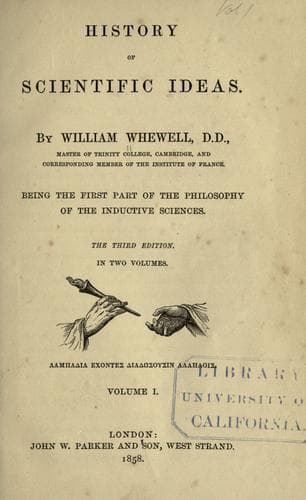
[The Philosophy of the Inductive Sciences, according to our
view, must be founded upon the History of such Sciences;
which history we have attempted in a former work. The events
of that history may be described generally as the rise of
Theories out of Facts. But besides this, which we may term
the _external_ history of Theories, there is an internal
history of Theories, namely, the series of steps by which
the human mind becomes capable of forming each Theory. Hence
to complete the History of the Sciences as derived from
Facts, we require a history of the Ideas by which such
derivation has been made possible: and thus, the _First
Part_ of our Philosophy must be a _History of Scientific
Ideas_;--a labour no less historical than our former work,
and concerned with the same events; but which has been
purposely kept separate during the {17} composition, in
order that it might be afterwards presented in a more
systematic form, which I have here attempted to do.
Scientific Ideas are the Conditions of the derivation of
Sciences from Facts: but can any method or methods be given
by which such a Derivation can be ensured, or at least,
aided? Many such methods have been proposed; of which the
most celebrated is the _Novum Organon_ of Bacon, of which
the title was intended to imply that its scope goes much
beyond the _Organon_ of Aristotle. With the experience of
the formation of Science which the world has had since
Bacon's time, it does not appear presumptuous to suppose
that we can now improve or correct his methods; nor to term
such an attempt _Novum Organon Renovatum_.
The Philosophy of the Inductive Sciences, then, contains
these two parts, _The History of Scientific Ideas_, and the
_Novum Organon Renovatum_.]
{{19}}
THE
PHILOSOPHY
OF THE
INDUCTIVE SCIENCES.
PART I.
HISTORY OF SCIENTIFIC IDEAS.
Public-domain text, read in full here on John Shaqi.
Reviews
Reviews
No reviews yet
Be the first to share your thoughts on this work.
Join the Discussion
Join the discussion
Sign in to leave a comment or review.
Sign InorCreate an account