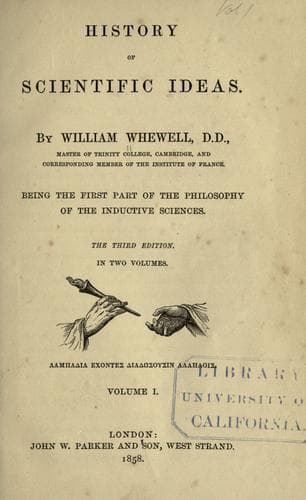
[We have just spoken of _Theories_ and _Facts_, of _Ideas_
and _Facts_, and of _Inductive_ Sciences, which imply the
opposition of _Induction_ and _Deduction_. The explanation
of these antitheses must be the starting point of our
Philosophy.]
[Knowledge grows, and] through the ages one increasing purpose runs,
And the thoughts of men are widen'd with the process of the Suns.
BOOK I.
OF IDEAS IN GENERAL.
Quæ adhuc inventa sunt in Scientiis, ea hujusmodi sunt ut
Notionibus Vulgaribus fere subjaceant: ut vero ad interiora
et remotiora Naturæ penetretur, necesse est ut tam NOTIONES
quam AXIOMATA magis certâ et munitâ viâ a particularibus
abstrahantur; atque omnino melior et certior intellectûs
adoperatio in usum veniat.
BACON, _Nov. Org._, Lib. 1. Aphor. xviii.
{{23}}
BOOK I.
OF IDEAS IN GENERAL.
CHAPTER I.
OF THE FUNDAMENTAL ANTITHESIS OF PHILOSOPHY.
_Sect._ 1.--_Thoughts and Things._
IN order that we may do something towards determining the
nature and conditions of human knowledge, (which I have
already stated as the purpose of this work,) I shall have to
refer to an antithesis or opposition, which is familiar and
generally recognized, and in which the distinction of the
things opposed to each other is commonly considered very
clear and plain. I shall have to attempt to make this
opposition sharper and stronger than it is usually
conceived, and yet to shew that the distinction is far from
being so clear and definite as it is usually assumed to be:
I shall have to point the contrast, yet shew that the things
which are contrasted cannot be separated:--I must explain
that the antithesis is constant and essential, but yet that
there is no fixed and permanent line dividing its members. I
may thus appear, in different parts of my discussion, to be
proceeding in opposite directions, but I hope that the
reader who gives me a patient attention will see that both
steps lead to the point of view to which I wish to lead him.
The antithesis or opposition of which I speak is denoted,
with various modifications, by various pairs of terms: I
shall endeavour to shew the connexion of these different
modes of expression, and I will begin with that form which
is the simplest and most idiomatic. {24}
The simplest and most idiomatic expression of the antithesis
to which I refer is that in which we oppose to each other
THINGS and THOUGHTS. The opposition is familiar and plain.
Our thoughts are something which belongs to ourselves;
something which takes place within us; they are what we
think; they are actions of our minds. Things, on the
contrary, are something different from ourselves and
independent of us; something which is without us; they
_are_; we see them, touch them, and thus know that they
exist; but we do not make them by seeing or touching them,
as we make our _Thoughts_ by thinking them; we are passive,
and _Things_ act upon our organs of perception.
Public-domain text, read in full here on John Shaqi.
Reviews
Reviews
No reviews yet
Be the first to share your thoughts on this work.
Join the Discussion
Join the discussion
Sign in to leave a comment or review.
Sign InorCreate an account