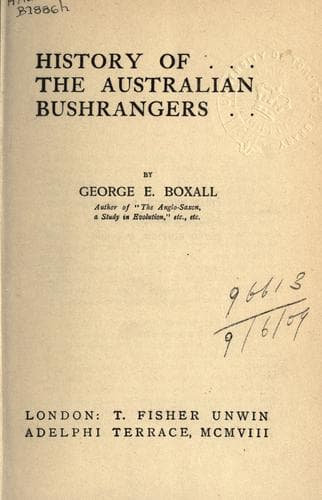
History of the Australian BushrangersBoxall, George
History
History of the Australian Bushrangers
Boxall, George
Bushrangers -- Australia
the general experience of bushmen, the settler may have been justified
in killing the black. He may have been simply treating him according to
the blackfellow's own rule in war time. But although we may acquit the
settler of blame by such reasoning, the existence of such conditions
as to necessitate such a war is not the less deplorable. The whites
all carried arms when travelling, and even while working about their
homes. Shepherds and other workmen went in pairs. There was no safety
anywhere outside the cleared lands round the larger towns. Reviewing
the whole situation from our present standpoint, it is difficult to say
what other measures could have been adopted than those tried by the
Government. The authorities were apparently incapable of controlling
the bushrangers, nor could they prevent convicts from running away,
and these outlaws appear to have always considered the blacks as
fair game. Mr. Robertson tells us that a convict known as "Carrots"
boasted shortly before his death that, "having killed a native in his
attempt to carry off the black's wife, he cut off the dead man's head
and obliged the woman to go with him carrying it suspended round her
neck."[24] Is it any wonder that even such "passive and inoffensive
creatures" as the Van Diemen's Land blacks are said to have been,
should have been aroused to fury by such methods? But although the
Government had no control over the convicts in the bush, and such
outrages as this were not known of until long after they had occurred,
it can scarcely be said that even Governor Arthur, in spite of his
earnest desire to protect the blacks, was altogether blameless. The
whole policy of the Government in relation to the blacks was weak and
vacillating. Governor Arthur promised a native, known as Teague, a boat
on condition that he should assist in the capture of some bushrangers.
The black performed his share of the work, but he never got his boat,
and is said to have fretted himself to death in consequence. The Sydney
black, Musquito, was forced "into the bush" by the failure of the
Government to protect him against the persecution due to the manner
in which he had been employed in the service of that Government. In
September, 1826, two blacks were hung in Hobart Town "to impress the
others." Nothing could be more absurd than this, and it was far more
barbarous a method of reprisal than the shooting of a "poor cowering
black." But the Government was not even consistent in its savagery.
At the trial of Eumarrah Mr. Robertson pleaded that the black was
justified in resisting the invaders of his country in any and every
way; and, on his undertaking to remove Eumarrah to Flinders Island,
where he had collected about thirty-eight blacks under the charge of
missionaries, the plea was accepted and the prisoner was handed over to
him. By this time, however, the war had become so vindictive that even
the authorities in London recognised that the blacks must be captured
Public-domain text, read in full here on John Shaqi.
Reviews
Reviews
No reviews yet
Be the first to share your thoughts on this work.
Join the Discussion
Join the discussion
Sign in to leave a comment or review.
Sign InorCreate an account