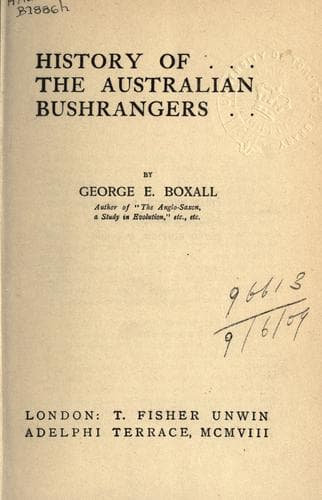
History of the Australian BushrangersBoxall, George
History
History of the Australian Bushrangers
Boxall, George
Bushrangers -- Australia
or annihilated, and consequently permission was granted to Governor
Arthur to put in practice the most extraordinary project perhaps ever
attempted.
In April, 1828, a proclamation was issued which, after describing the
state of tension which existed between whites and blacks, exhorted
all well-disposed persons to assist the Government in attempting to
establish peace and order. The proclamation went on to explain that a
cordon was to be drawn round the disturbed area and that this was to be
gradually contracted until the natives were either captured or driven
across the narrow isthmus which connects Tasman's peninsula with the
main portion of the island. "But I do, nevertheless, hereby strictly
order, enjoin, and command, that the actual use of arms be in no case
resorted to, by firing against any of the natives, or otherwise, if
they can by other measures be captured."
The force employed in this gigantic scheme is said to have been about
two thousand two hundred men, of whom five hundred and fifty were
soldiers belonging to the 63rd, the 57th, and the 17th regiments. The
whole force was divided into parties of about ten each, and one of
these was appointed a leader. On October 7th, a chain of posts was
established from St. Patrick's Head along the rivers St. Paul, South
Esk, Macquarie, and Meander, under the command of Major Douglas, of
the 63rd regiment. A similar chain of posts was formed from the Derwent
River along the River Dee to the Lakes, under Captain Wentworth, of
the 63rd regiment. A third party, under Captain Donaldson, of the 57th
regiment, was stationed in the rear to capture any blacks who might
escape through the front line. Captain Moriarty, R.N., in charge of
a party, was appointed to scour between the lines and to drive the
natives forward or capture them. Mr. Gilbert Robertson and other
friends of the blacks acted with this group of parties with the object
of persuading such natives as they might meet to surrender quietly.
For about three weeks the posts were advanced slowly, and frequent
reports were circulated that the beaters had seen parties of blacks
and that they were going in the desired direction. On the 25th Mr.
Walpole reported that he had come on a camp of blacks and saw them
lighting their fires and cooking as if nothing unusual was going on.
He watched all night, and just before daybreak crept up slowly and
found five blacks asleep. He seized one and held him after a desperate
struggle, during which the black bit him severely on the arm. A boy
of about fifteen was captured by another settler who was with Mr.
Walpole, and these two were handed over to the authorities and conveyed
to the nearest police station to be kept until the remainder were
captured. On the 26th Lieutenant Ovens saw a black with a firestick
apparently trying to sneak through the lines. He ran forward and the
black retreated into the bush. Several other blacks were turned back
from other points in the line. These also carried firesticks.
Public-domain text, read in full here on John Shaqi.
Reviews
Reviews
No reviews yet
Be the first to share your thoughts on this work.
Join the Discussion
Join the discussion
Sign in to leave a comment or review.
Sign InorCreate an account