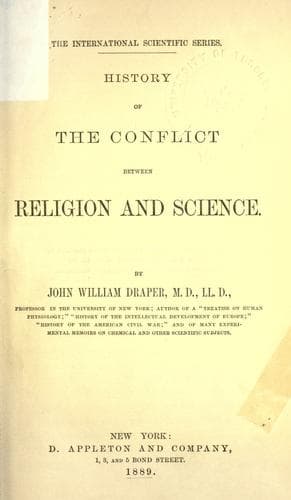
History of the Conflict Between Religion and ScienceDraper, John William
Religion
History of the Conflict Between Religion and Science
Draper, John William
Religion and science -- History
But the inevitable day came at length. Assertions and doctrines based
upon such preposterous evidence were involved in the discredit that fell
upon the evidence itself. As the thirteenth century is approached, we
find unbelief in all directions setting in. First, it is plainly seen
among the monastic orders, then it spreads rapidly among the common
people. Books, such as "The Everlasting Gospel," appear among the
former; sects, such as the Catharists, Waldenses, Petrobrussians, arise
among the latter. They agreed in this, "that the public and established
religion was a motley system of errors and superstitions, and that the
dominion which the pope had usurped over Christians was unlawful and
tyrannical; that the claim put forth by Rome, that the Bishop of Rome is
the supreme lord of the universe, and that neither princes nor bishops,
civil governors nor ecclesiastical rulers, have any lawful power in
church or state but what they receive from him, is utterly without
foundation, and a usurpation of the rights of man."
To withstand this flood of impiety, the papal government established two
institutions: 1. The Inquisition; 2. Auricular confession--the latter as
a means of detection, the former as a tribunal for punishment.
In general terms, the commission of the Inquisition was, to extirpate
religious dissent by terrorism, and surround heresy with the most
horrible associations; this necessarily implied the power of determining
what constitutes heresy. The criterion of truth was thus in possession
of this tribunal, which was charged "to discover and bring to judgment
heretics lurking in towns, houses, cellars, woods, caves, and fields."
With such savage alacrity did it carry out its object of protecting the
interests of religion, that between 1481 and 1808 it had punished three
hundred and forty thousand persons, and of these nearly thirty-two
thousand had been burnt! In its earlier days, when public opinion could
find no means of protesting against its atrocities, "it often put to
death, without appeal, on the very day that they were accused, nobles,
clerks, monks, hermits, and lay persons of every rank." In whatever
direction thoughtful men looked, the air was full of fearful shadows. No
one could indulge in freedom of thought without expecting punishment. So
dreadful were the proceedings of the Inquisition, that the exclamation
of Pagliarici was the exclamation of thousands: "It is hardly possible
for a man to be a Christian, and die in his bed."
The Inquisition destroyed the sectaries of Southern France in the
thirteenth century. Its unscrupulous atrocities extirpated Protestantism
in Italy and Spain. Nor did it confine itself to religious affairs; it
engaged in the suppression of political discontent. Nicolas Eymeric, who
was inquisitor-general of the kingdom of Aragon for nearly fifty years,
and who died in 1399, has left a frightful statement of its conduct and
appalling cruelties in his "Directorium Inquisitorum."
Public-domain text, read in full here on John Shaqi.
Reviews
Reviews
No reviews yet
Be the first to share your thoughts on this work.
Elsewhere in the archive
Join the Discussion
Join the discussion
Sign in to leave a comment or review.
Sign InorCreate an account