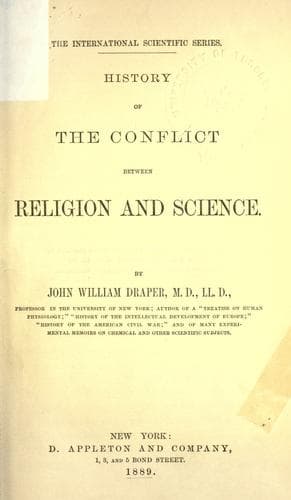
History of the Conflict Between Religion and ScienceDraper, John William
Religion
History of the Conflict Between Religion and Science
Draper, John William
Religion and science -- History
The historian Ranke, to whom I am indebted for many of these facts,
has depicted in a very graphic manner the demoralization of the great
metropolis. The popes were, for the most part, at their election, aged
men. Power was, therefore, incessantly passing into new hands. Every
election was a revolution in prospects and expectations. In a community
where all might rise, where all might aspire to all, it necessarily
followed that every man was occupied in thrusting some other into the
background. Though the population of the city at the inception of the
Reformation had sunk to eighty thousand, there were vast crowds of
placemen, and still greater ones of aspirants for place. The
successful occupant of the pontificate had thousands of offices to give
away--offices from many of which the incumbents had been remorselessly
ejected; many had been created for the purpose of sale. The integrity
and capacity of an applicant were never inquired into; the points
considered were, what services has he rendered or can he render to the
party? how much can he pay for the preferment? An American reader can
thoroughly realize this state of things. At every presidential election
he witnesses similar acts. The election of a pope by the Conclave is not
unlike the nomination of an American president by a convention. In both
cases there are many offices to give away.
William of Malmesbury says that in his day the Romans made a sale of
whatever was righteous and sacred for gold. After his time there was
no improvement; the Church degenerated into an instrument for the
exploitation of money. Vast sums were collected in Italy; vast sums
were drawn under all manner of pretenses from surrounding and reluctant
countries. Of these the most nefarious was the sale of indulgences
for the perpetration of sin. Italian religion had become the art of
plundering the people.
For more than a thousand years the sovereign pontiffs had been rulers
of the city. True, it had witnessed many scenes of devastation for which
they were not responsible; but they were responsible for this, that they
had never made any vigorous, any persistent effort for its material, its
moral improvement. Instead of being in these respects an exemplar for
the imitation of the world, it became an exemplar of a condition that
ought to be shunned. Things steadily went on from bad to worse, until
at the epoch of the Reformation no pious stranger could visit it without
being shocked.
Public-domain text, read in full here on John Shaqi.
Reviews
Reviews
No reviews yet
Be the first to share your thoughts on this work.
Elsewhere in the archive
Join the Discussion
Join the discussion
Sign in to leave a comment or review.
Sign InorCreate an account