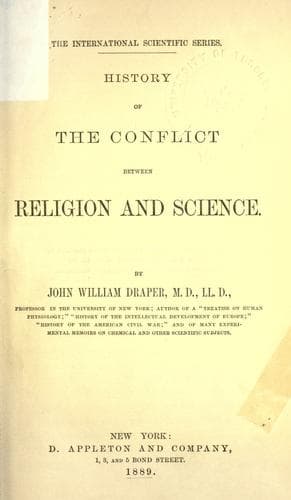
History of the Conflict Between Religion and ScienceDraper, John William
Religion
History of the Conflict Between Religion and Science
Draper, John William
Religion and science -- History
The papacy, repudiating science as absolutely incompatible with its
pretensions, had in later years addressed itself to the encouragement of
art. But music and painting, though they may be exquisite adornments
of life, contain no living force that can develop a weak nation into a
strong one; nothing that can permanently assure the material well-being
or happiness of communities; and hence at the time of the Reformation,
to one who thoughtfully considered her condition, Rome had lost all
living energy. She was no longer the arbiter of the physical or the
religious progress of the world. For the progressive maxims of the
republic and the empire, she had substituted the stationary maxims of
the papacy. She had the appearance of piety and the possession of art.
In this she resembled one of those friar-corpses which we still see in
their brown cowls in the vaults of the Cappuccini, with a breviary or
some withered flowers in its hands.
From this view of the Eternal City, this survey of what Latin
Christianity had done for Rome itself, let us turn to the whole European
Continent. Let us try to determine the true value of the system that was
guiding society; let us judge it by its fruits.
The condition of nations as to their well-being is most precisely
represented by the variations of their population. Forms of government
have very little influence on population, but policy may control it
completely.
It has been very satisfactorily shown by authors who have given
attention to the subject, that the variations of population depend
upon the interbalancing of the generative force of society and the
resistances to life.
By the generative force of society is meant that instinct which
manifests itself in the multiplication of the race. To some extent it
depends on climate; but, since the climate of Europe did not sensibly
change between the fourth and the sixteenth centuries, we may regard
this force as having been, on that continent, during the period under
consideration, invariable.
By the resistances to life is meant whatever tends to make individual
existence more difficult of support. Among such may be enumerated
insufficient food, inadequate clothing, imperfect shelter.
It is also known that, if the resistances become inappreciable, the
generative force will double a population in twenty-five years.
The resistances operate in two modes: 1. Physically; since they diminish
the number of births, and shorten the term of the life of all. 2.
Intellectually; since, in a moral, and particularly in a religious
community, they postpone marriage, by causing individuals to decline
its responsibilities until they feel that they are competent to meet
the charges and cares of a family. Hence the explanation of a
long-recognized fact, that the number of marriages during a given period
has a connection with the price of food.
Public-domain text, read in full here on John Shaqi.
Reviews
Reviews
No reviews yet
Be the first to share your thoughts on this work.
Elsewhere in the archive
Join the Discussion
Join the discussion
Sign in to leave a comment or review.
Sign InorCreate an account