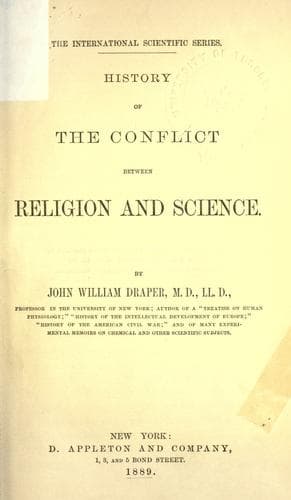
History of the Conflict Between Religion and ScienceDraper, John William
Religion
History of the Conflict Between Religion and Science
Draper, John William
Religion and science -- History
The increase of population keeps pace with the increase of food; and,
indeed, such being the power of the generative force, it overpasses the
means of subsistence, establishing a constant pressure upon them. Under
these circumstances, it necessarily happens that a certain amount of
destitution must occur. Individuals have come into existence who must be
starved.
As illustrations of the variations that have occurred in the population
of different countries, may be mentioned the immense diminution of that
of Italy in consequence of the wars of Justinian; the depopulation of
North Africa in consequence of theological quarrels; its restoration
through the establishment of Mohammedanism; the increase of that of all
Europe through the feudal system, when estates became more valuable in
proportion to the number of retainers they could supply. The crusades
caused a sensible diminution, not only through the enormous army losses,
but also by reason of the withdrawal of so many able-bodied men
from marriage-life. Similar variations have occurred on the American
Continent. The population of Mexico was very quickly diminished by two
million through the rapacity and atrocious cruelty of the Spaniards, who
drove the civilized Indians to despair. The same happened in Peru.
The population of England at the Norman conquest was about two million.
In five hundred years it had scarcely doubled. It may be supposed that
this stationary condition was to some extent induced by the papal policy
of the enforcement of celibacy in the clergy. The "legal generative
force" was doubtless affected by that policy, the "actual generative
force" was not. For those who have made this subject their study have
long ago been satisfied that public celibacy is private wickedness. This
mainly determined the laity, as well as the government in England, to
suppress the monasteries. It was openly asserted that there were one
hundred thousand women in England made dissolute by the clergy.
In my history of the "American Civil War," I have presented some
reflections on this point, which I will take the liberty of quoting
here: "What, then, does this stationary condition of the population
mean? It means, food obtained with hardship, insufficient clothing,
personal uncleanness, cabins that could not keep out the weather,
the destructive effects of cold and heat, miasm, want of sanitary
provisions, absence of physicians, uselessness of shrine-cure, the
deceptiveness of miracles, in which society was putting its trust; or,
to sum up a long catalogue of sorrows, wants, and sufferings, in one
term--it means a high death-rate.
"But more; it means deficient births. And what does that point out?
Marriage postponed, licentious life, private wickedness, demoralized
society.
Public-domain text, read in full here on John Shaqi.
Reviews
Reviews
No reviews yet
Be the first to share your thoughts on this work.
Elsewhere in the archive
Join the Discussion
Join the discussion
Sign in to leave a comment or review.
Sign InorCreate an account