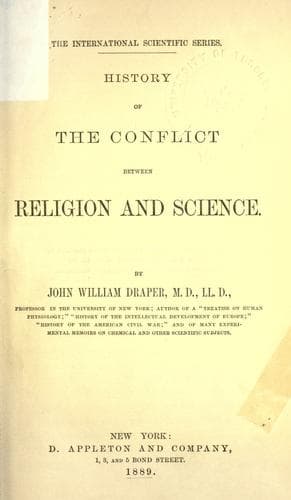
History of the Conflict Between Religion and ScienceDraper, John William
Religion
History of the Conflict Between Religion and Science
Draper, John William
Religion and science -- History
The most potent instrument of the new papal system was Gratian's
Decretum, which was issued about the middle of the twelfth century. It
was a mass of fabrications. It made the whole Christian world, through
the papacy, the domain of the Italian clergy. It inculcated that it is
lawful to constrain men to goodness, to torture and execute heretics,
and to confiscate their property; that to kill an excommunicated person
is not murder; that the pope, in his unlimited superiority to all law,
stands on an equality with the Son of God!
As the new system of centralization developed, maxims, that in the olden
times would have been held to be shocking, were boldly avowed--the whole
Church is the property of the pope to do with as he will; what is simony
in others is not simony in him; he is above all law, and can be called
to account by none; whoever disobeys him must be put to death; every
baptized man is his subject, and must for life remain so, whether he
will or not. Up to the end of the twelfth century, the popes were the
vicars of Peter; after Innocent III. they were the vicars of Christ.
But an absolute sovereign has need of revenues, and to this the popes
were no exception. The institution of legates was brought in from
Hildebrand's time. Sometimes their duty was to visit churches, sometimes
they were sent on special business, but always invested with unlimited
powers to bring back money over the Alps. And since the pope could not
only make laws, but could suspend their operation, a legislation was
introduced in view to the purchase of dispensations. Monasteries were
exempted from episcopal jurisdiction on payment of a tribute to Rome.
The pope had now become "the universal bishop;" he had a concurrent
jurisdiction in all the dioceses, and could bring any cases before
his own courts. His relation to the bishops was that of an absolute
sovereign to his officials. A bishop could resign only by his
permission, and sees vacated by resignation lapsed to him. Appeals to
him were encouraged in every way for the sake of the dispensations;
thousands of processes came before the Curia, bringing a rich harvest to
Rome. Often when there were disputing claimants to benefices, the
pope would oust them all, and appoint a creature of his own. Often the
candidates had to waste years in Rome, and either died there, or carried
back a vivid impression of the dominant corruption. Germany suffered
more than other countries from these appeals and processes, and hence
of all countries was best prepared for the Reformation. During the
thirteenth and fourteenth centuries the popes made gigantic strides in
the acquisition of power. Instead of recommending their favorites for
benefices, now they issued mandates. Their Italian partisans must
be rewarded; nothing could be done to satisfy their clamors, but to
provide for them in foreign countries. Shoals of contesting claimants
died in Rome; and, when death took place in that city, the Pope claimed
Public-domain text, read in full here on John Shaqi.
Reviews
Reviews
No reviews yet
Be the first to share your thoughts on this work.
Elsewhere in the archive
Join the Discussion
Join the discussion
Sign in to leave a comment or review.
Sign InorCreate an account