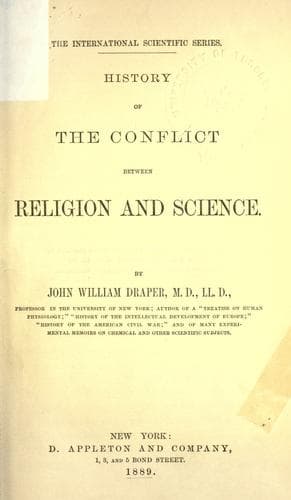
History of the Conflict Between Religion and ScienceDraper, John William
Religion
History of the Conflict Between Religion and Science
Draper, John William
Religion and science -- History
1. For the perpetuation of knowledge. Orders were given to the chief
librarian to buy at the king's expense whatever books he could. A body
of transcribers was maintained in the Museum, whose duty it was to make
correct copies of such works as their owners were not disposed to sell.
Any books brought by foreigners into Egypt were taken at once to the
Museum, and, when correct copies had been made, the transcript was given
to the owner, and the original placed in the library. Often a very large
pecuniary indemnity was paid. Thus it is said of Ptolemy Euergetes
that, having obtained from Athens the works of Euripides, Sophocles,
and Aeschylus, he sent to their owners transcripts, together with about
fifteen thousand dollars, as an indemnity. On his return from the Syrian
expedition he carried back in triumph all the Egyptian monuments from
Ecbatana and Susa, which Cambyses and other invaders had removed from
Egypt. These he replaced in their original seats, or added as adornments
to his museums. When works were translated as well as transcribed, sums
which we should consider as almost incredible were paid, as was the
case with the Septuagint translation of the Bible, ordered by Ptolemy
Philadelphus.
2. For the increase of knowledge. One of the chief objects of the Museum
was that of serving as the home of a body of men who devoted themselves
to study, and were lodged and maintained at the king's expense.
Occasionally he himself sat at their table. Anecdotes connected with
those festive occasions have descended to our times. In the original
organization of the Museum the residents were divided into four
faculties--literature; mathematics, astronomy, medicine. Minor branches
were appropriately classified under one of these general heads; thus
natural history was considered to be a branch of medicine. An officer of
very great distinction presided over the establishment, and had general
charge of its interests. Demetrius Phalareus, perhaps the most learned
man of his age, who had been governor of Athens for many years, was the
first so appointed. Under him was the librarian, an office sometimes
held by men whose names have descended to our times, as Eratosthenes,
and Apollonius Rhodius.
Public-domain text, read in full here on John Shaqi.
Reviews
Reviews
No reviews yet
Be the first to share your thoughts on this work.
Join the Discussion
Join the discussion
Sign in to leave a comment or review.
Sign InorCreate an account