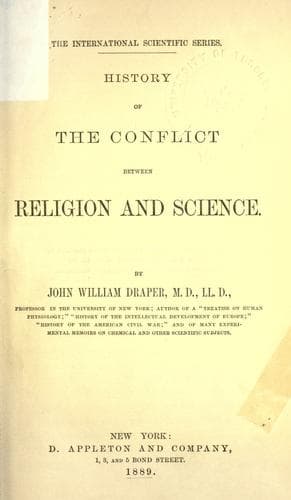
History of the Conflict Between Religion and Science — John Shaqi
History of the Conflict Between Religion and ScienceDraper, John William
Religion
History of the Conflict Between Religion and Science
Draper, John William
Religion and science -- History
ORGANIZATION OF THE MUSEUM. In connection with the Museum were a
botanical and a zoological garden. These gardens, as their names import,
were for the purpose of facilitating the study of plants and animals.
There was also an astronomical observatory containing armillary spheres,
globes, solstitial and equatorial armils, astrolabes, parallactic
rules, and other apparatus then in use, the graduation on the divided
instruments being into degrees and sixths. On the floor of this
observatory a meridian line was drawn. The want of correct means of
measuring time and temperature was severely felt; the clepsydra of
Ctesibius answered very imperfectly for the former, the hydrometer
floating in a cup of water for the latter; it measured variations of
temperature by variations of density. Philadelphus, who toward the close
of his life was haunted with an intolerable dread of death, devoted much
of his time to the discovery of an elixir. For such pursuits the Museum
was provided with a chemical laboratory. In spite of the prejudices of
the age, and especially in spite of Egyptian prejudices, there was
in connection with the medical department an anatomical room for the
dissection, not only of the dead, but actually of the living, who for
crimes had been condemned.
3. For the diffusion of knowledge. In the Museum was given, by lectures,
conversation, or other appropriate methods instruction in all the
various departments of human knowledge. There flocked to this great
intellectual centre, students from all countries. It is said that at one
time not fewer than fourteen thousand were in attendance. Subsequently
even the Christian church received from it some of the most eminent of
its Fathers, as Clemens Alexandrinus, Origen, Athanasius.
The library in the Museum was burnt during the siege of Alexandria by
Julius Caesar. To make amends for this great loss, that collected
by Eumenes, King of Pergamus, was presented by Mark Antony to Queen
Cleopatra. Originally it was founded as a rival to that of the
Ptolemies. It was added to the collection in the Serapion.
SCIENTIFIC SCHOOL OF THE MUSEUM. It remains now to describe briefly the
philosophical basis of the Museum, and some of its contributions to the
stock of human knowledge.
In memory of the illustrious founder of this most noble institution--an
institution which antiquity delighted to call "The divine school of
Alexandria"--we must mention in the first rank his "History of the
Campaigns of Alexander." Great as a soldier and as a sovereign, Ptolemy
Soter added to his glory by being an author. Time, which has not been
able to destroy the memory of our obligations to him, has dealt unjustly
by his work. It is not now extant.
Public-domain text, read in full here on John Shaqi.
Reviews
Reviews
No reviews yet
Be the first to share your thoughts on this work.
Join the Discussion
Join the discussion
Sign in to leave a comment or review.
Sign InorCreate an account