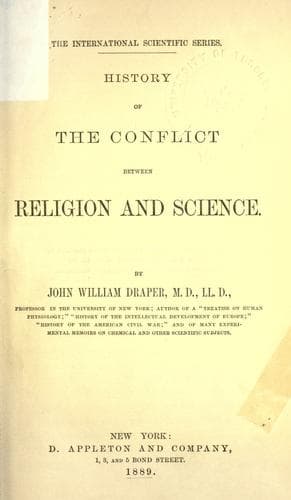
History of the Conflict Between Religion and ScienceDraper, John William
Religion
History of the Conflict Between Religion and Science
Draper, John William
Religion and science -- History
As might be expected from the friendship that existed between Alexander,
Ptolemy, and Aristotle, the Aristotelian philosophy was the intellectual
corner-stone on which the Museum rested. King Philip had committed the
education of Alexander to Aristotle, and during the Persian campaigns
the conqueror contributed materially, not only in money, but otherwise,
toward the "Natural History" then in preparation.
The essential principle of the Aristotelian philosophy was, to rise
from the study of particulars to a knowledge of general principles or
universals, advancing to them by induction. The induction is the
more certain as the facts on which it is based are more numerous; its
correctness is established if it should enable us to predict other facts
until then unknown. This system implies endless toil in the collection
of facts, both by experiment and observation; it implies also a close
meditation on them. It is, therefore, essentially a method of labor
and of reason, not a method of imagination. The failures that Aristotle
himself so often exhibits are no proof of its unreliability, but
rather of its trustworthiness. They are failures arising from want of a
sufficiency of facts.
ETHICAL SCHOOL OF THE MUSEUM. Some of the general results at which
Aristotle arrived are very grand. Thus, he concluded that every thing is
ready to burst into life, and that the various organic forms presented
to us by Nature are those which existing conditions permit. Should
the conditions change, the forms will also change. Hence there is an
unbroken chain from the simple element through plants and animals up to
man, the different groups merging by insensible shades into each other.
The inductive philosophy thus established by Aristotle is a method of
great power. To it all the modern advances in science are due. In
its most improved form it rises by inductions from phenomena to their
causes, and then, imitating the method of the Academy, it descends by
deductions from those causes to the detail of phenomena.
While thus the Scientific School of Alexandria was founded on the maxims
of one great Athenian philosopher, the Ethical School was founded on the
maxims of another, for Zeno, though a Cypriote or Phoenician, had for
many years been established at Athens. His disciples took the name of
Stoics. His doctrines long survived him, and, in times when there was no
other consolation for man, offered a support in the hour of trial, and
an unwavering guide in the vicissitudes of life, not only to illustrious
Greeks, but also to many of the great philosophers, statesmen, generals,
and emperors of Rome.
Public-domain text, read in full here on John Shaqi.
Reviews
Reviews
No reviews yet
Be the first to share your thoughts on this work.
Join the Discussion
Join the discussion
Sign in to leave a comment or review.
Sign InorCreate an account