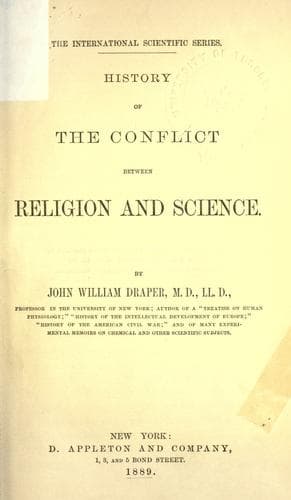
History of the Conflict Between Religion and ScienceDraper, John William
Religion
History of the Conflict Between Religion and Science
Draper, John William
Religion and science -- History
THE ITALIAN GOVERNMENT. The Italian troops met with but little
resistance. They occupied Rome on September 20, 1870. A manifesto was
issued, setting forth the details of a plebiscitum, the vote to be by
ballot, the question, "the unification of Italy." Its result showed how
completely the popular mind in Italy is emancipated from theology. In
the Roman provinces the number of votes on the lists was 167,548; the
number who voted, 135,291; the number who voted for annexation, 133,681;
the number who voted against it, 1,507; votes annulled, 103. The
Parliament of Italy ratified the vote of the Roman people for annexation
by a vote of 239 to 20. A royal decree now announced the annexation of
the Papal States to the kingdom of Italy, and a manifesto was issued
indicating the details of the arrangement. It declared that "by these
concessions the Italian Government seeks to prove to Europe that Italy
respects the sovereignty of the pope in conformity with the principle of
a free Church in a free state."
AFFAIRS IN PRUSSIA. In the Prusso-Austrian War it had been the hope of
the papacy, to restore the German Empire under Austria, and make
Germany a Catholic nation. In the Franco-German War the French expected
ultramontane sympathies in Germany. No means were spared to excite
Catholic sentiment against the Protestants. No vilification was spared.
They were spoken of as atheists; they were declared incapable of being
honest men; their sects were pointed out as indicating that their
secession was in a state of dissolution. "The followers of Luther are
the most abandoned men in all Europe." Even the pope himself, presuming
that the whole world had forgotten all history, did not hesitate to say,
"Let the German people understand that no other Church but that of Rome
is the Church of freedom and progress."
Meantime, among the clergy of Germany a party was organized to
remonstrate against, and even resist, the papal usurpation. It protested
against "a man being placed on the throne of God," against a vice-God
of any kind, nor would it yield its scientific convictions to
ecclesiastical authority. Some did not hesitate to accuse the
pope himself of being a heretic. Against these insubordinates
excommunications began to be fulminated, and at length it was demanded
that certain professors and teachers should be removed from their
offices, and infallibilists substituted. With this demand the Prussian
Government declined to comply.
Public-domain text, read in full here on John Shaqi.
Reviews
Reviews
No reviews yet
Be the first to share your thoughts on this work.
Elsewhere in the archive
Join the Discussion
Join the discussion
Sign in to leave a comment or review.
Sign InorCreate an account