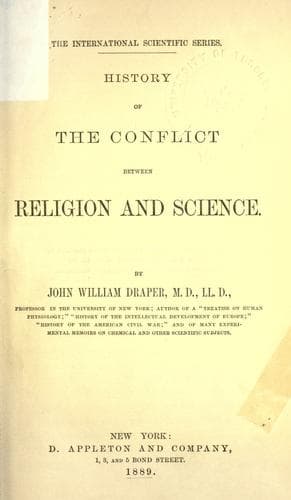
History of the Conflict Between Religion and ScienceDraper, John William
Religion
History of the Conflict Between Religion and Science
Draper, John William
Religion and science -- History
Of the various Protestant denominations, several had associated
themselves, for the purposes of consultation, under the designation of
the Evangelical Alliance. Their last meeting was held in New York, in
the autumn of 1873. Though, in this meeting, were gathered together many
pious representatives of the Reformed Churches, European and American,
it had not the prestige nor the authority of the Great Council that had
just previously closed its sessions in St. Peters, at Rome. It could
not appeal to an unbroken ancestry of far more than a thousand years;
it could not speak with the authority of an equal and, indeed, of
a superior to emperors and kings. While profound intelligence and a
statesmanlike, worldly wisdom gleamed in every thing that the Vatican
Council had done, the Evangelical Alliance met without a clear and
precise view of its objects, without any definitely-marked intentions.
Its wish was to draw into closer union the various Protestant Churches,
but it had no well-grounded hope of accomplishing that desirable result.
It illustrated the necessary working, of the principle on which
those Churches originated. They were founded on dissent and exist by
separation.
Yet in the action of the Evangelical Alliance may be discerned
certain very impressive facts. It averted its eyes from its ancient
antagonist--that antagonist which had so recently loaded the Reformation
with contumely and denunciation--it fastened them, as the Vatican
Council had done, on Science. Under that dreaded name there stood before
it what seemed to be a spectre of uncertain form, of hourly-dilating
proportions, of threatening aspect. Sometimes the Alliance addressed
this stupendous apparition in words of courtesy, sometimes in tones of
denunciation.
THE VATICAN CONSTITUTION CRITICISED. The Alliance failed to perceive
that modern Science is the legitimate sister--indeed, it is the
twin-sister--of the Reformation. They were begotten together and
were born together. It failed to perceive that, though there is an
impossibility of bringing into coalition the many conflicting sects,
they may all find in science a point of connection; and that, not a
distrustful attitude toward it, but a cordial union with it, is their
true policy.
It remains now to offer some reflections on this "Constitution of the
Catholic Faith," as defined by the Vatican Council.
For objects to present themselves under identical relations to different
persons, they must be seen from the same point of view. In the instance
we are now considering, the religious man has his own especial station;
the scientific man another, a very different one. It is not for either
to demand that his co-observer shall admit that the panorama of facts
spread before them is actually such as it appears to him to be.
Public-domain text, read in full here on John Shaqi.
Reviews
Reviews
No reviews yet
Be the first to share your thoughts on this work.
Elsewhere in the archive
Join the Discussion
Join the discussion
Sign in to leave a comment or review.
Sign InorCreate an account