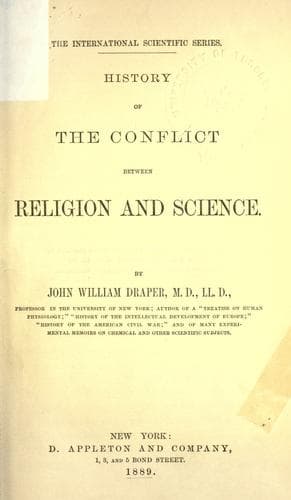
History of the Conflict Between Religion and ScienceDraper, John William
Religion
History of the Conflict Between Religion and Science
Draper, John William
Religion and science -- History
The Dogmatic Constitution insists on the admission of this postulate,
that the Roman Church acts under a divine commission, specially and
exclusively delivered to it. In virtue of that great authority, it
requires of all men the surrender of their intellectual convictions, and
of all nations the subordination of their civil power.
But a claim so imposing must be substantiated by the most decisive and
unimpeachable credentials; proofs, not only of an implied and indirect
kind, but clear, emphatic, and to the point; proofs that it would be
impossible to call in question.
The Church, however, declares, that she will not submit her claim to
the arbitrament of human reason; she demands that it shall be at once
conceded as an article of faith.
If this be admitted, all bar requirements must necessarily be assented
to, no matter how exorbitant they may be.
With strange inconsistency the Dogmatic Constitution deprecates reason,
affirming that it cannot determine the points under consideration, and
yet submits to it arguments for adjudication. In truth, it might be said
that the whole composition is a passionate plea to Reason to stultify
itself in favor of Roman Christianity.
With points of view so widely asunder, it is impossible that Religion
and Science should accord in their representation of things. Nor can
any conclusion in common be reached, except by an appeal to Reason as a
supreme and final judge.
There are many religions in the world, some of them of more venerable
antiquity, some having far more numerous adherents, than the Roman. How
can a selection be made among them, except by such an appeal to Reason?
Religion and Science must both submit their claims and their dissensions
to its arbitrament.
Against this the Vatican Council protests. It exalts faith to a
superiority over reason; it says that they constitute two separate
orders of knowledge, having respectively for their objects mysteries
and facts. Faith deals with mysteries, reason with facts. Asserting the
dominating superiority of faith, it tries to satisfy the reluctant mind
with miracles and prophecies.
On the other hand, Science turns away from the incomprehensible, and
rests herself on the maxim of Wiclif: "God forceth not a man to believe
that which he cannot understand." In the absence of an exhibition of
satisfactory credentials on the part of her opponent, she considers
whether there be in the history of the papacy, and in the biography of
the popes, any thing that can adequately sustain a divine commission,
any thing that can justify pontifical infallibility, or extort that
unhesitating obedience which is due to the vice-God.
Public-domain text, read in full here on John Shaqi.
Reviews
Reviews
No reviews yet
Be the first to share your thoughts on this work.
Elsewhere in the archive
Join the Discussion
Join the discussion
Sign in to leave a comment or review.
Sign InorCreate an account