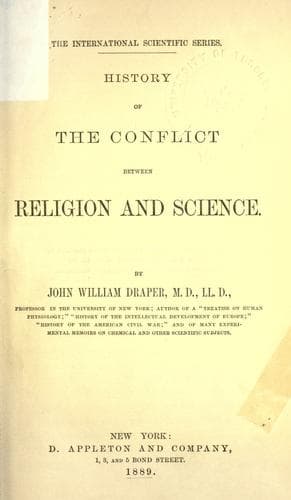
History of the Conflict Between Religion and ScienceDraper, John William
Religion
History of the Conflict Between Religion and Science
Draper, John William
Religion and science -- History
One of the most striking and yet contradictory features of the Dogmatic
Constitution is, the reluctant homage it pays to the intelligence of
man. It presents a definition of the philosophical basis of Catholicism,
but it veils from view the repulsive features of the vulgar faith. It
sets forth the attributes of God, the Creator of all things, in words
fitly designating its sublime conception, but it abstains from affirming
that this most awful and eternal Being was born of an earthly mother,
the wife of a Jewish carpenter, who has since become the queen of
heaven. The God it depicts is not the God of the middle ages, seated
on his golden throne, surrounded by choirs of angels, but the God of
Philosophy. The Constitution has nothing to say about the Trinity,
nothing of the worship due to the Virgin--on the contrary, that is by
implication sternly condemned; nothing about transubstantiation, or
the making of the flesh and blood of God by the priest; nothing of the
invocation of the saints. It bears on its face subordination to the
thought of the age, the impress of the intellectual progress of man.
THE PASSAGE OF EUROPE TO LLAMAISM. Such being the exposition rendered to
us respecting the attributes of God, it next instructs us as to his
mode of government of the world. The Church asserts that she possesses a
supernatural control over all material and moral events. The priesthood,
in its various grades, can determine issues of the future, either by the
exercise of its inherent attributes, or by its influential invocation of
the celestial powers. To the sovereign pontiff it has been given to bind
or loose at his pleasure. It is unlawful to appeal from his judgments
to an Oecumenical Council, as if to an earthly arbiter superior to him.
Powers such as these are consistent with arbitrary rule, but they are
inconsistent with the government of the world by immutable law. Hence
the Dogmatic Constitution plants itself firmly in behalf of incessant
providential interventions; it will not for a moment admit that in
natural things there is an irresistible sequence of events, or in the
affairs of men an unavoidable course of acts.
Public-domain text, read in full here on John Shaqi.
Reviews
Reviews
No reviews yet
Be the first to share your thoughts on this work.
Elsewhere in the archive
Join the Discussion
Join the discussion
Sign in to leave a comment or review.
Sign InorCreate an account