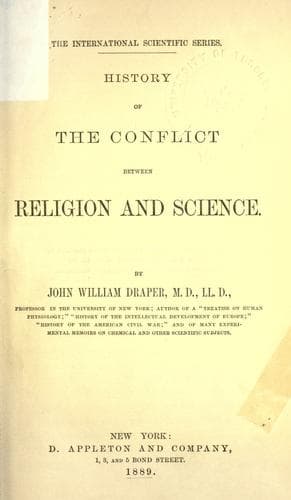
History of the Conflict Between Religion and ScienceDraper, John William
Religion
History of the Conflict Between Religion and Science
Draper, John William
Religion and science -- History
On a country to which in its political extremity the indigenous gods
have been found unable to give any protection, a change of faith is
impending. The venerable divinities of Egypt, to whose glory obelisks
had been raised and temples dedicated, had again and again submitted
to the sword of a foreign conqueror. In the land of the Pyramids, the
Colossi, the Sphinx, the images of the gods had ceased to represent
living realities. They had ceased to be objects of faith. Others of more
recent birth were needful, and Serapis confronted Osiris. In the shops
and streets of Alexandria there were thousands of Jews who had forgotten
the God that had made his habitation behind the veil of the temple.
Tradition, revelation, time, all had lost their influence. The
traditions of European mythology, the revelations of Asia, the
time-consecrated dogmas of Egypt, all had passed or were fast passing
away. And the Ptolemies recognized how ephemeral are forms of faith.
But the Ptolemies also recognized that there is something more durable
than forms of faith, which, like the organic forms of geological ages,
once gone, are clean gone forever, and have no restoration, no return.
They recognized that within this world of transient delusions and
unrealities there is a world of eternal truth.
That world is not to be discovered through the vain traditions that
have brought down to us the opinions of men who lived in the morning of
civilization, nor in the dreams of mystics who thought that they were
inspired. It is to be discovered by the investigations of geometry,
and by the practical interrogation of Nature. These confer on humanity
solid, and innumerable, and inestimable blessings.
The day will never come when any one of the propositions of Euclid will
be denied; no one henceforth will call in question the globular shape of
the earth, as recognized by Eratosthenes; the world will not permit
the great physical inventions and discoveries made in Alexandria and
Syracuse to be forgotten. The names of Hipparchus, of Apollonius, of
Ptolemy, of Archimedes, will be mentioned with reverence by men of every
religious profession, as long as there are men to speak.
THE MUSEUM AND MODERN SCIENCE. The Museum of Alexandria was thus
the birthplace of modern science. It is true that, long before its
establishment, astronomical observations had been made in China and
Mesopotamia; the mathematics also had been cultivated with a certain
degree of success in India. But in none of these countries had
investigation assumed a connected and consistent form; in none was
physical experimentation resorted to. The characteristic feature of
Alexandrian, as of modern science, is, that it did not restrict itself
to observation, but relied on a practical interrogation of Nature.
CHAPTER II.
THE ORIGIN OF CHRISTIANITY.--ITS TRANSFORMATION ON ATTAINING
IMPERIAL POWER.--ITS RELATIONS TO SCIENCE.
Public-domain text, read in full here on John Shaqi.
Reviews
Reviews
No reviews yet
Be the first to share your thoughts on this work.
Join the Discussion
Join the discussion
Sign in to leave a comment or review.
Sign InorCreate an account