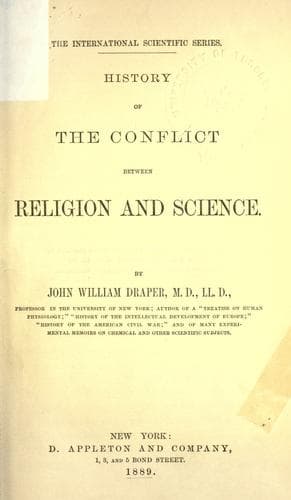
History of the Conflict Between Religion and Science — John Shaqi
History of the Conflict Between Religion and ScienceDraper, John William
Religion
History of the Conflict Between Religion and Science
Draper, John William
Religion and science -- History
Religious condition of the Roman Republic.--The adoption of
imperialism leads to monotheism.--Christianity spreads over
the Roman Empire.--The circumstances under which it
attained imperial power make its union with Paganism a
political necessity.--Tertullian's description of its
doctrines and practices.--Debasing effect of the policy of
Constantine on it.--Its alliance with the civil power.--Its
incompatibility with science.--Destruction of the
Alexandrian Library and prohibition of philosophy.--
Exposition of the Augustinian philosophy and Patristic
science generally.--The Scriptures made the standard of
science.
IN a political sense, Christianity is the bequest of the Roman Empire to
the world.
At the epoch of the transition of Rome from the republican to the
imperial form of government, all the independent nationalities around
the Mediterranean Sea had been brought under the control of that central
power. The conquest that had befallen them in succession had been by no
means a disaster. The perpetual wars they had maintained with each
other came to an end; the miseries their conflicts had engendered were
exchanged for universal peace.
Not only as a token of the conquest she had made but also as a
gratification to her pride, the conquering republic brought the gods
of the vanquished peoples to Rome. With disdainful toleration, she
permitted the worship of them all. That paramount authority exercised by
each divinity in his original seat disappeared at once in the crowd of
gods and goddesses among whom he had been brought. Already, as we have
seen, through geographical discoveries and philosophical criticism,
faith in the religion of the old days had been profoundly shaken. It
was, by this policy of Rome, brought to an end.
MONOTHEISM IN THE ROMAN EMPIRE. The kings of all the conquered provinces
had vanished; in their stead one emperor had come. The gods also had
disappeared. Considering the connection which in all ages has existed
between political and religious ideas, it was then not at all strange
that polytheism should manifest a tendency to pass into monotheism.
Accordingly, divine honors were paid at first to the deceased and at
length to the living emperor.
The facility with which gods were thus called into existence had a
powerful moral effect. The manufacture of a new one cast ridicule on
the origin of the old Incarnation in the East and apotheosis in the West
were fast filling Olympus with divinities. In the East, gods descended
from heaven, and were made incarnate in men; in the West, men ascended
from earth, and took their seat among the gods. It was not the
importation of Greek skepticism that made Rome skeptical. The excesses
of religion itself sapped the foundations of faith.
Public-domain text, read in full here on John Shaqi.
Reviews
Reviews
No reviews yet
Be the first to share your thoughts on this work.
Join the Discussion
Join the discussion
Sign in to leave a comment or review.
Sign InorCreate an account