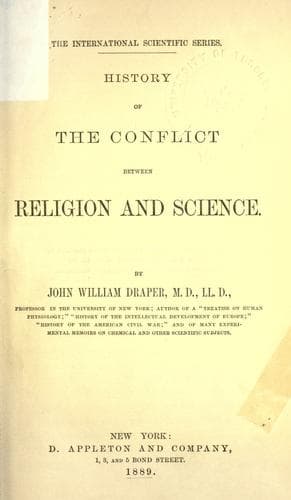
History of the Conflict Between Religion and ScienceDraper, John William
Religion
History of the Conflict Between Religion and Science
Draper, John William
Religion and science -- History
These Holy Scriptures teach us that there is one God, who made the world
out of nothing, who, though daily seen, is invisible; his infiniteness
is known only to himself; his immensity conceals, but at the same
time discovers him. He has ordained for men, according to their lives,
rewards and punishments; he will raise all the dead that have ever lived
from the creation of the world, will command them to reassume their
bodies, and thereupon adjudge them to felicity that has so end, or to
eternal flames. The fires of hell are those hidden flames which the
earth shuts up in her bosom. He has in past times sent into the world
preachers or prophets. The prophets of those old times were Jews; they
addressed their oracles, for such they were, to the Jews, who
have stored them up in the Scriptures. On them, as has been said,
Christianity is founded, though the Christian differs in his ceremonies
from the Jew. We are accused of worshiping a man, and not the God of
the Jews. Not so. The honor we bear to Christ does not derogate from the
honor we bear to God.
On account of the merit of these ancient patriarchs, the Jews were the
only beloved people of God; he delighted to be in communication with
them by his own mouth. By him they were raised to admirable greatness.
But with perversity they wickedly ceased to regard him; they changed
his laws into a profane worship. He warned them that he would take to
himself servants more faithful than they, and, for their crime, punished
them by driving them forth from their country. They are now spread all
over the world; they wander in all parts; they cannot enjoy the air they
breathed at their birth; they have neither man nor God for their king.
As he threatened them, so he has done. He has taken, in all nations
and countries of the earth, people more faithful than they. Through his
prophets he had declared that these should have greater favors, and that
a Messiah should come, to publish a new law among them. This Messiah was
Jesus, who is also God. For God may be derived from God, as the light
of a candle may be derived from the light of another candle. God and his
Son are the self-same God--a light is the same light as that from which
it was taken.
Public-domain text, read in full here on John Shaqi.
Reviews
Reviews
No reviews yet
Be the first to share your thoughts on this work.
Join the Discussion
Join the discussion
Sign in to leave a comment or review.
Sign InorCreate an account