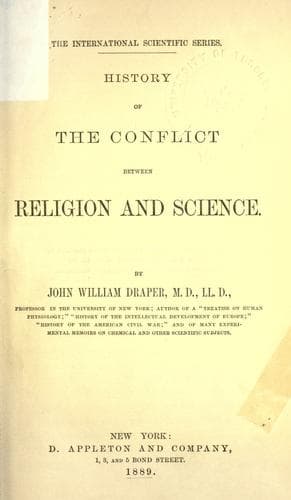
History of the Conflict Between Religion and ScienceDraper, John William
Religion
History of the Conflict Between Religion and Science
Draper, John William
Religion and science -- History
With no inconsiderable skill Tertullian opens his argument. He tells
the magistrates that Christianity is a stranger upon earth, and that she
expects to meet with enemies in a country which is not her own. She only
asks that she may not be condemned unheard, and that Roman magistrates
will permit her to defend herself; that the laws of the empire will
gather lustre, if judgment be passed upon her after she has been tried
but not if she is sentenced without a hearing of her cause; that it is
unjust to hate a thing of which we are ignorant, even though it may be a
thing worthy of hate; that the laws of Rome deal with actions, not with
mere names; but that, notwithstanding this, persons have been punished
because they were called Christians, and that without any accusation of
crime.
He then advances to an exposition of the origin, the nature, and the
effects of Christianity, stating that it is founded on the Hebrew
Scriptures, which are the most venerable of all books. He says to the
magistrates: "The books of Moses, in which God has inclosed, as in
a treasure, all the religion of the Jews, and consequently all the
Christian religion, reach far beyond the oldest you have, even beyond
all your public monuments, the establishment of your state, the
foundation of many great cities--all that is most advanced by you in all
ages of history, and memory of times; the invention of letters, which
are the interpreters of sciences and the guardians of all excellent
things. I think I may say more--beyond your gods, your temples, your
oracles and sacrifices. The author of those books lived a thousand years
before the siege of Troy, and more than fifteen hundred before Homer."
Time is the ally of truth, and wise men believe nothing but what is
certain, and what has been verified by time. The principal authority
of these Scriptures is derived from their venerable antiquity. The most
learned of the Ptolemies, who was surnamed Philadelphus, an accomplished
prince, by the advice of Demetrius Phalareus, obtained a copy of these
holy books. It may be found at this day in his library. The divinity of
these Scriptures is proved by this, that all that is done in our days
may be found predicted in them; they contain all that has since passed
in the view of men.
Is not the accomplishment of a prophecy a testimony to its truth? Seeing
that events which are past have vindicated these prophecies, shall we be
blamed for trusting them in events that are to come? Now, as we believe
things that have been prophesied and have come to pass, so we believe
things that have been told us, but not yet come to pass, because they
have all been foretold by the same Scriptures, as well those that are
verified every day as those that still remain to be fulfilled.
Public-domain text, read in full here on John Shaqi.
Reviews
Reviews
No reviews yet
Be the first to share your thoughts on this work.
Join the Discussion
Join the discussion
Sign in to leave a comment or review.
Sign InorCreate an account