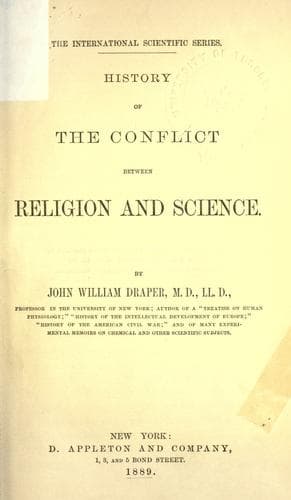
History of the Conflict Between Religion and Science — John Shaqi
History of the Conflict Between Religion and ScienceDraper, John William
Religion
History of the Conflict Between Religion and Science
Draper, John William
Religion and science -- History
Though Christians deny that the emperor is a god, they nevertheless pray
for his prosperity, because the general dissolution that threatens the
universe, the conflagration of the world, is retarded so long as the
glorious majesty of the triumphant Roman Empire shall last. They desire
not to be present at the subversion of all Nature. They acknowledge
only one republic, but it is the whole world; they constitute one body,
worship one God, and all look forward to eternal happiness. Not only do
they pray for the emperor and the magistrates, but also for peace. They
read the Scriptures to nourish their faith, lift up their hope, and
strengthen the confidence they have in God. They assemble to exhort one
another; they remove sinners from their societies; they have bishops who
preside over them, approved by the suffrages of those whom they are to
conduct. At the end of each month every one contributes if he will, but
no one is constrained to give; the money gathered in this manner is
the pledge of piety; it is not consumed in eating and drinking, but
in feeding the poor, and burying them, in comforting children that are
destitute of parents and goods, in helping old men who have spent the
best of their days in the service of the faithful, in assisting those
who have lost by shipwreck what they had, and those who are condemned
to the mines, or have been banished to islands, or shut up in prisons,
because they professed the religion of the true God. There is but one
thing that Christians have not in common, and that one thing is their
wives. They do not feast as if they should die to-morrow, nor build
as if they should never die. The objects of their life are innocence,
justice, patience, temperance, chastity.
To this noble exposition of Christian belief and life in his day,
Tertullian does not hesitate to add an ominous warning to the
magistrates he is addressing--ominous, for it was a forecast of a great
event soon to come to pass: "Our origin is but recent, yet already we
fill all that your power acknowledges--cities, fortresses, islands,
provinces, the assemblies of the people, the wards of Rome, the palace,
the senate, the public places, and especially the armies. We have
left you nothing but your temples. Reflect what wars we are able to
undertake! With what promptitude might we not arm ourselves were we not
restrained by our religion, which teaches us that it is better to be
killed than to kill!"
Before he closes his defense, Tertullian renews an assertion which,
carried into practice, as it subsequently was, affected the intellectual
development of all Europe. He declares that the Holy Scriptures are a
treasure from which all the true wisdom in the world has been drawn;
that every philosopher and every poet is indebted to them. He labors
to show that they are the standard and measure of all truth, and that
whatever is inconsistent with them must necessarily be false.
Public-domain text, read in full here on John Shaqi.
Reviews
Reviews
No reviews yet
Be the first to share your thoughts on this work.
Join the Discussion
Join the discussion
Sign in to leave a comment or review.
Sign InorCreate an account