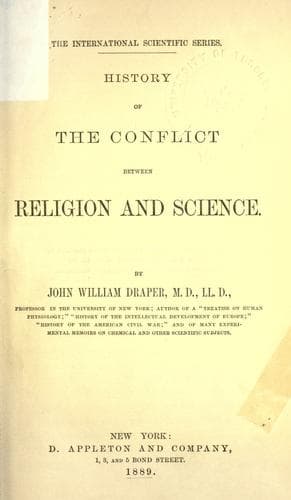
History of the Conflict Between Religion and ScienceDraper, John William
Religion
History of the Conflict Between Religion and Science
Draper, John William
Religion and science -- History
For this reason I have had little to say respecting the two great
Christian confessions, the Protestant and Greek Churches. As to the
latter, it has never, since the restoration of science, arrayed itself
in opposition to the advancement of knowledge. On the contrary, it has
always met it with welcome. It has observed a reverential attitude to
truth, from whatever quarter it might come. Recognizing the apparent
discrepancies between its interpretations of revealed truth and the
discoveries of science, it has always expected that satisfactory
explanations and reconciliations would ensue, and in this it has not
been disappointed. It would have been well for modern civilization if
the Roman Church had done the same.
In speaking of Christianity, reference is generally made to the
Roman Church, partly because its adherents compose the majority of
Christendom, partly because its demands are the most pretentious, and
partly because it has commonly sought to enforce those demands by
the civil power. None of the Protestant Churches has ever occupied a
position so imperious--none has ever had such wide-spread political
influence. For the most part they have been averse to constraint, and
except in very few instances their opposition has not passed beyond the
exciting of theological odium.
As to Science, she has never sought to ally herself to civil power. She
has never attempted to throw odium or inflict social ruin on any human
being. She has never subjected any one to mental torment, physical
torture, least of all to death, for the purpose of upholding or
promoting her ideas. She presents herself unstained by cruelties and
crimes. But in the Vatican--we have only to recall the Inquisition--the
hands that are now raised in appeals to the Most Merciful are crimsoned.
They have been steeped in blood!
There are two modes of historical composition, the artistic and the
scientific. The former implies that men give origin to events; it
therefore selects some prominent individual, pictures him under
a fanciful form, and makes him the hero of a romance. The latter,
insisting that human affairs present an unbroken chain, in which each
fact is the offspring of some preceding fact, and the parent of some
subsequent fact, declares that men do not control events, but that
events control men. The former gives origin to compositions, which,
however much they may interest or delight us, are but a grade above
novels; the latter is austere, perhaps even repulsive, for it sternly
impresses us with a conviction of the irresistible dominion of law, and
the insignificance of human exertions. In a subject so solemn as that to
which this book is devoted, the romantic and the popular are altogether
out of place. He who presumes to treat of it must fix his eyes
steadfastly on that chain of destiny which universal history displays;
he must turn with disdain from the phantom impostures of pontiffs and
statesmen and kings.
Public-domain text, read in full here on John Shaqi.
Reviews
Reviews
No reviews yet
Be the first to share your thoughts on this work.
Join the Discussion
Join the discussion
Sign in to leave a comment or review.
Sign InorCreate an account