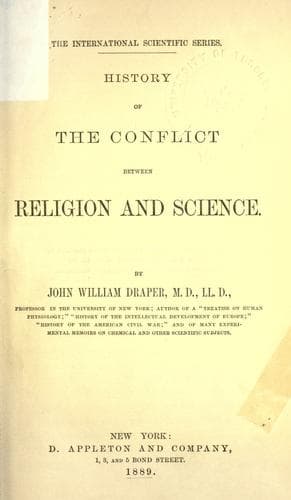
History of the Conflict Between Religion and ScienceDraper, John William
Religion
History of the Conflict Between Religion and Science
Draper, John William
Religion and science -- History
If any thing were needed to show us the untrustworthiness of artistic
historical compositions, our personal experience would furnish it. How
often do our most intimate friends fail to perceive the real motives of
our every-day actions; how frequently they misinterpret our intentions!
If this be the case in what is passing before our eyes, may we not
be satisfied that it is impossible to comprehend justly the doings of
persons who lived many years ago, and whom we have never seen.
In selecting and arranging the topics now to be presented, I have been
guided in part by "the Confession" of the late Vatican Council, and in
part by the order of events in history. Not without interest will the
reader remark that the subjects offer themselves to us now as they did
to the old philosophers of Greece. We still deal with the same questions
about which they disputed. What is God? What is the soul? What is the
world? How is it governed? Have we any standard or criterion of truth?
And the thoughtful reader will earnestly ask, "Are our solutions of
these problems any better than theirs?"
The general argument of this book, then, is as follows:
I first direct attention to the origin of modern science as
distinguished from ancient, by depending on observation, experiment,
and mathematical discussion, instead of mere speculation, and shall show
that it was a consequence of the Macedonian campaigns, which brought
Asia and Europe into contact. A brief sketch of those campaigns, and of
the Museum of Alexandria, illustrates its character.
Then with brevity I recall the well-known origin of Christianity, and
show its advance to the attainment of imperial power, the transformation
it underwent by its incorporation with paganism, the existing religion
of the Roman Empire. A clear conception of its incompatibility with
science caused it to suppress forcibly the Schools of Alexandria. It was
constrained to this by the political necessities of its position.
The parties to the conflict thus placed, I next relate the story of
their first open struggle; it is the first or Southern Reformation. The
point in dispute had respect to the nature of God. It involved the rise
of Mohammedanism. Its result was, that much of Asia and Africa, with the
historic cities Jerusalem, Alexandria, and Carthage, were wrenched from
Christendom, and the doctrine of the Unity of God established in the
larger portion of what had been the Roman Empire.
Public-domain text, read in full here on John Shaqi.
Reviews
Reviews
No reviews yet
Be the first to share your thoughts on this work.
Join the Discussion
Join the discussion
Sign in to leave a comment or review.
Sign InorCreate an account