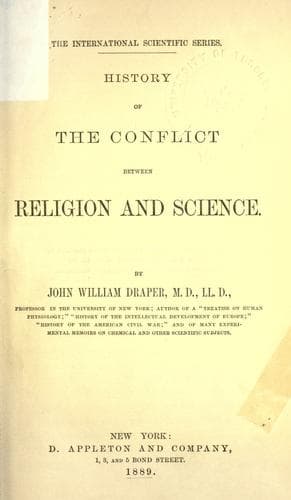
History of the Conflict Between Religion and ScienceDraper, John William
Religion
History of the Conflict Between Religion and Science
Draper, John William
Religion and science -- History
Four centuries before the birth of Christ, Greece was fast outgrowing
her ancient faith. Her philosophers, in their studies of the world, had
been profoundly impressed with the contrast between the majesty of the
operations of Nature and the worthlessness of the divinities of Olympus.
Her historians, considering the orderly course of political affairs,
the manifest uniformity in the acts of men, and that there was no event
occurring before their eyes for which they could not find an obvious
cause in some preceding event, began to suspect that the miracles and
celestial interventions, with which the old annals were filled, were
only fictions. They demanded, when the age of the supernatural had
ceased, why oracles had become mute, and why there were now no more
prodigies in the world.
Traditions, descending from immemorial antiquity, and formerly accepted
by pious men as unquestionable truths, had filled the islands of
the Mediterranean and the conterminous countries with supernatural
wonders--enchantresses, sorcerers, giants, ogres, harpies, gorgons,
centaurs, cyclops. The azure vault was the floor of heaven; there Zeus,
surrounded by the gods with their wives and mistresses, held his court,
engaged in pursuits like those of men, and not refraining from acts of
human passion and crime.
A sea-coast broken by numerous indentations, an archipelago with some of
the most lovely islands in the world, inspired the Greeks with a taste
for maritime life, for geographical discovery, and colonization.
Their ships wandered all over the Black and Mediterranean Seas. The
time-honored wonders that had been glorified in the "Odyssey," and
sacred in public faith, were found to have no existence. As a better
knowledge of Nature was obtained, the sky was shown to be an illusion;
it was discovered that there is no Olympus, nothing above but space and
stars. With the vanishing of their habitation, the gods disappeared,
both those of the Ionian type of Homer and those of the Doric of Hesiod.
Public-domain text, read in full here on John Shaqi.
Reviews
Reviews
No reviews yet
Be the first to share your thoughts on this work.
Join the Discussion
Join the discussion
Sign in to leave a comment or review.
Sign InorCreate an account