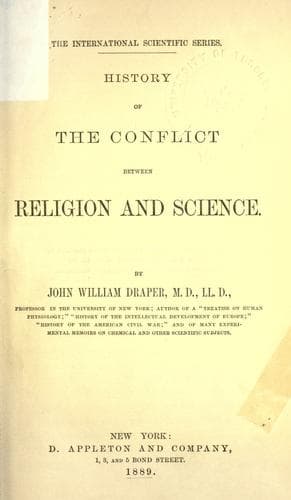
History of the Conflict Between Religion and ScienceDraper, John William
Religion
History of the Conflict Between Religion and Science
Draper, John William
Religion and science -- History
While solitary insects do not live to raise their young, social insects
have a longer term, they exhibit moral affections and educate
their offspring. Patterns of patience and industry, some of these
insignificant creatures will work sixteen or eighteen hours a day. Few
men are capable of sustained mental application more than four or five
hours.
Similarity of effects indicates similarity of causes; similarity of
actions demands similarity of organs. I would ask the reader of these
paragraphs, who is familiar with the habits of animals, and especially
with the social relations of that wonderful insect to which reference
has been made, to turn to the nineteenth chapter of my work on
the "Intellectual Development of Europe," in which he will find a
description of the social system of the Incas of Peru. Perhaps, then, in
view of the similarity of the social institutions and personal conduct
of the insect, and the social institutions and personal conduct of the
civilized Indian--the one an insignificant speck, the other a man--he
will not be disposed to disagree with me in the opinion that "from bees,
and wasps, and ants, and birds, from all that low animal life on which
he looks with supercilious contempt, man is destined one day to learn
what in truth he really is."
The views of Descartes, who regarded all insects as automata, can
scarcely be accepted without modification. Insects are automata only
so far as the action of their ventral cord, and that portion of their
cephalic ganglia which deals with contemporaneous impressions, is
concerned.
It is one of the functions of vesicular-nervous material to retain
traces or relics of impressions brought to it by the organs of sense;
hence, nervous ganglia, being composed of that material, may be
considered as registering apparatus. They also introduce the element
of time into the action of the nervous mechanism. An impression, which
without them might have forthwith ended in reflex action, is delayed,
and with this duration come all those important effects arising through
the interaction of many impressions, old and new, upon each other.
There is no such thing as a spontaneous, or self-originated, thought.
Every intellectual act is the consequence of some preceding act. It
comes into existence in virtue of something that has gone before. Two
minds constituted precisely alike, and placed under the influence of
precisely the same environment, must give rise to precisely the same
thought. To such sameness of action we allude in the popular expression
"common-sense"--a term full of meaning. In the origination of a
thought there are two distinct conditions: the state of the organism
as dependent on antecedent impressions, and on the existing physical
circumstances.
Public-domain text, read in full here on John Shaqi.
Reviews
Reviews
No reviews yet
Be the first to share your thoughts on this work.
Elsewhere in the archive
Join the Discussion
Join the discussion
Sign in to leave a comment or review.
Sign InorCreate an account