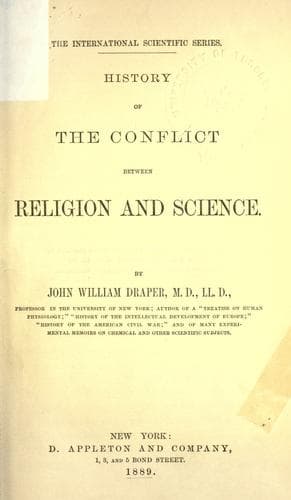
History of the Conflict Between Religion and ScienceDraper, John William
Religion
History of the Conflict Between Religion and Science
Draper, John William
Religion and science -- History
In the cephalic ganglia of insects are stored up the relics of
impressions that have been made upon the common peripheral nerves, and
in them are kept those which are brought in by the organs of special
sense--the visual, olfactive, auditory. The interaction of these raises
insects above mere mechanical automata, in which the reaction instantly
follows the impression.
In all cases the action of every nerve-centre, no matter what its stage
of development may be, high or low, depends upon an essential chemical
condition--oxidation. Even in man, if the supply of arterial blood
be stopped but for a moment, the nerve-mechanism loses its power; if
diminished, it correspondingly declines; if, on the contrary, it
be increased--as when nitrogen monoxide is breathed--there is more
energetic action. Hence there arises a need of repair, a necessity for
rest and sleep.
Two fundamental ideas are essentially attached to all our perceptions
of external things: they are SPACE and TIME, and for these provision is
made in the nervous mechanism while it is yet in an almost rudimentary
state. The eye is the organ of space, the ear of time; the perceptions
of which by the elaborate mechanism of these structures become
infinitely more precise than would be possible if the sense of touch
alone were resorted to.
There are some simple experiments which illustrate the vestiges of
ganglionic impressions. If on a cold, polished metal, as a new razor,
any object, such as a wafer, be laid, and the metal be then breathed
upon, and, when the moisture has had time to disappear, the wafer be
thrown off, though now the most critical inspection of the polished
surface can discover no trace of any form, if we breathe once more upon
it, a spectral image of the wafer comes plainly into view; and this may
be done again and again. Nay, more, if the polished metal be carefully
put aside where nothing can deteriorate its surface, and be so kept for
many months, on breathing again upon it the shadowy form emerges.
Such an illustration shows how trivial an impression may be thus
registered and preserved. But, if, on such an inorganic surface, an
impression may thus be indelibly marked, how much more likely in the
purposely-constructed ganglion! A shadow never falls upon a wall without
leaving thereupon a permanent trace, a trace which might be made visible
by resorting to proper processes. Photographic operations are cases in
point. The portraits of our friends, or landscape views, may be hidden
on the sensitive surface from the eye, but they are ready to make their
appearance as soon as proper developers are resorted to. A spectre is
concealed on a silver or glassy surface until, by our necromancy, we
make it come forth into the visible world. Upon the walls of our most
private apartments, where we think the eye of intrusion is altogether
shut out and our retirement can never be profaned, there exist the
vestiges of all our acts, silhouettes of whatever we have done.
Public-domain text, read in full here on John Shaqi.
Reviews
Reviews
No reviews yet
Be the first to share your thoughts on this work.
Elsewhere in the archive
Join the Discussion
Join the discussion
Sign in to leave a comment or review.
Sign InorCreate an account