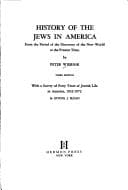
History of the Jews in America: From the Period of the Discovery of the New World to the Present TimeWiernik, Peter
History
History of the Jews in America: From the Period of the Discovery of the New World to the Present Time
Wiernik, Peter
Jews -- America -- History; Jews -- United States -- History
We have seen in the preceding chapter that the Jews were expelled
forever from Spain and Portugal at the time when these two nations,
with considerable assistance from professing and converted Jews,
discovered the New World and took possession of it. Nothing could
therefore have been farther from the thoughts and the hopes of the Jews
of those dark days than the idea that America was to be, in a far-away
future, the first Christian country to grant its Jewish inhabitants
full citizenship and absolute equality before the law. For nearly a
century and a half no professing Jew dared to tread upon American soil,
and even the secret Jews or Marranos were as much in danger in the
newly-planted colonies as in the mother countries under whose rule they
remained for a long time.
The first Jewish immigrants in the New World were children who were
torn away from the arms of their parents at the time of the expulsions,
and even they were persecuted as soon as they grew up. The Marranos who
sought a refuge in America in these early days were soon followed by
the same agencies of persecution which made life a burden to them in
their old home. We meet in America for more than a century after its
discovery almost the same conditions as in Spain and Portugal after the
Jews were exiled. Where the history of the Jews in Spain ends――says Dr.
Kayserling――the history of the Jews in America begins. The Inquisition
is the last chapter in the record of the confessors of Judaism on the
Pyrenean peninsula and its first chapter in the western hemisphere. The
Nuevos Christianos concealed their faith, or were able to conceal it,
as little in the New World as in the mother country. With astonishing
tenacity, nay, with admirable obstinacy, they clung to the religion
of their fathers; it was not a rare occurrence that the grandchildren
and great-grandchildren of the martyred Jews sanctified the Sabbath
in a most conscientious manner, by refraining from work as far as
possible and by wearing their best clothing. They also celebrated the
Jewish Festivals, observed the Day of Atonement by fasting, and married
according to the Jewish customs. They clung to their faith and suffered
for it even as late as the eighteenth century, which means that the
Jewish religion was handed down secretly and preserved in the seventh
and eighth generation after the exile. Many went to the stake or died
in the prisons of the Inquisition in the New World; many others were
transported in groups to Spain and Portugal and gave up their lives as
martyrs in Seville, Toledo, Evora or Lisbon. Their religious heroism
will be apparent in all its magnitude when the immense documentary
material which is heaped up in the archives of Spain and Portugal,
and other places on this side of the ocean, will have been sifted and
worked up. (“Publications,” II, p. 73.)
Public-domain text, read in full here on John Shaqi.
Reviews
Reviews
No reviews yet
Be the first to share your thoughts on this work.
Join the Discussion
Join the discussion
Sign in to leave a comment or review.
Sign InorCreate an account